You don’t have to choose full neurodivergent homeschooling or nothing. This guide covers education options in Australia – homeschool, distance education, and flexi-schooling – to help you choose what fits your child’s needs.

Education Options In Australia For Neurodivergent Homeschooling

School can train us to believe there’s one “right” education path – and if you don’t pick it quickly, you’re failing.

So when school stops fitting, you can end up spiralling between options. Homeschool? Distance education? Flexi-school? A mix? And because your child’s needs are real (and your capacity is not infinite), the pressure can feel enormous – even when you’re trying to find a calmer way forward.

Here’s what matters most:

You don’t have to choose “full homeschool or nothing”. There are flexible education options , and it’s allowed to choose what fits this season – then reassess later.

On this page, I’ll walk you through the main pathways in Australia (home education, distance education, flexi / part-time options where available, and hybrid approaches), plus a simple way to choose based on capacity and support needs – not perfection.

Quick Summary (so you can breathe)

  • There are multiple legitimate pathways – you’re not locked into one forever.
  • The “best” option is the one your family can sustain without constant conflict.
  • Structure can help, but pressure-heavy structure often backfires.
  • You can stabilise first, then plan learning.

The Calm Reframe: You’re Choosing A Pathway, Not A Personality

This decision can feel like it says something about you. Like if you pick the “wrong” thing, you’re reckless. Or lazy. Or overreacting. Or making it all too hard. But this isn’t a personality test. It’s a practical choice about:

  • what your child can cope with right now
  • what your family can sustain
  • what makes learning feel reachable again

You’re allowed to choose what fits now – and change it later.

Option 1: Home Education (Homeschooling)

Home education means you take responsibility for your child’s education at home (with registration requirements that vary by state/territory).

Why Some Families Choose It

  • maximum flexibility with pacing, environment, breaks, and supports
  • easier to reduce transitions and time pressure
  • works well with interest-led learning, unit studies, and self-directed learning

Best For

  • families coming out of a high-stress season
  • children who need a lower sensory and social load to function
  • families who want learning shaped around the child (not the system)

Watch Outs (Without Panic)

  • parent load can creep up fast, especially if you try to replicate school
  • it can feel isolating if you don’t build gentle connection points

Remember: you’re not building a “school at home”. You’re building learning that fits your child – without burning you out.

Hands flip through a world atlas beside a globe and a tablet showing an online lesson with a map. A study table with books and supplies suggests different education options for learning geography and history at home.

Option 2: Distance Education / Online School

Distance education is still schooling, but delivered remotely. Depending on the provider, it can include structured lessons, teacher contact, set expectations, and reporting.

Why Some Families Choose It

  • structure is provided (less planning load for parents)
  • clear learning scaffolds can reduce “what am I meant to do?” stress
  • it can feel like a middle ground between school and full homeschool

Best For

  • families who want a clearer framework to lean on
  • children who cope better with predictable expectations
  • parents who need support with planning and sequencing

Watch Outs

  • it can become timetable-heavy (which can reintroduce pressure)
  • screen-heavy learning doesn’t suit every child
  • eligibility and enrolment rules may apply (especially within public systems)

NSW Note (Gentle And Factual): In NSW public distance education, eligibility is considered using department procedures, and enrolment categories apply. Learn more.

Option 3: Flexi-Schooling / Part-Time Enrolment (Where Available)

This is where a child is enrolled at school for certain subjects or activities, while learning also happens at home (sometimes alongside home education registration, depending on your state rules).

Why Some Families Choose It

  • shared load (home + school)
  • access to specific subjects, facilities, or support
  • can be a bridge option while a child stabilises

Best For

  • children who can manage school in smaller doses
  • families who want some school connection without full-time attendance
  • kids who benefit from specific school-based opportunities

Watch Outs

  • it varies by state/territory and by school willingness
  • transitions can be the hardest part for many neurodivergent kids
  • pressure can creep back in if expectations don’t align

Victoria Example: Victoria explicitly describes “partial enrolment” as combining school and home education for certain subjects or activities. Learn more.

What To Ask A School Before You Agree

  • What does attendance actually look like (days, times, expectations)?
  • What happens if my child can’t attend on a hard day?
  • How flexible is this plan if stress rises?
  • Who is our key contact?
  • How will learning expectations be communicated (and adjusted)?

Option 4: Hybrid Approaches (Stabilise, Then Reassess)

Hybrid approaches are common, even when families don’t call them that.

This might look like:

  • homeschooling now while recovering – then reassessing later
  • distance education for structure + home-based projects and unit studies
  • part-time enrolment for specific needs + home learning for the rest

This isn’t indecision. It’s responsive planning.

How To Choose (Without Perfection)

This is the heart of the decision. Not “Which option is best in theory?” More like: “Which option protects our nervous system and keeps learning reachable?”

Choose Based On Capacity

  • your child’s current stress level and recovery needs
  • transition tolerance (how hard it is to switch tasks, places, expectations)
  • sensory load (noise, crowds, social performance, fatigue)
  • parent capacity and household load

Choose Based On Support Needs

  • what supports are essential right now (learning support, allied health, routine scaffolds)
  • what reduces daily conflict
  • what protects relationship and regulation

Choose Based On Sustainability

Ask: “What can we still do on a hard week?” That answer matters more than your best-week fantasy plan.

Evidence-Backed Notes

Need Space To Think This Through?

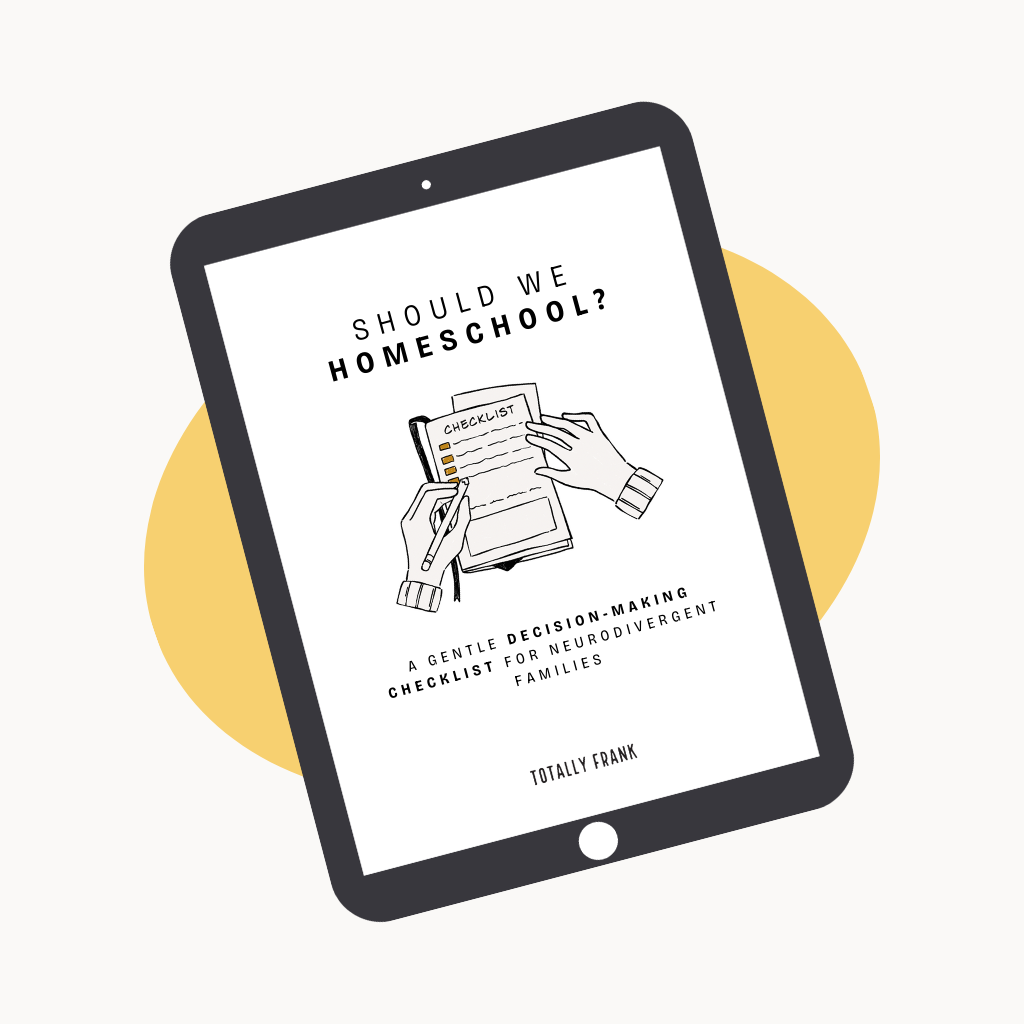
You don’t have to decide today. If your brain is spiralling between options (homeschool, distance ed, flexi-school), this checklist gives you a calmer way to think.

Should We Homeschool? is a free printable checklist for neurodivergent families who need space to pause, reflect, and explore what might fit – without pressure to commit or act straight away.

It helps you:

  • notice patterns (what’s working, what’s not)
  • check capacity (your child’s and yours)
  • clarify what you actually need from an education pathway

Download: Should We Homeschool? (Free Checklist)

Legal, But Calm: Check Your Local Requirements (Australia)

Education options and rules vary by state and territory. Use your education department or home education regulator as your source of truth.

If you’re starting from NSW, this is the simplest official starting point: NSW Government home schooling registration.

If you’re in the ACT, the ACT Government home education page includes guidance on registration (including part-time registration).

If you’re in Queensland, home education registration is managed through the Queensland Government education site.

For global readers: Search “home education registration + your state/country” and use your education department/regulator site as your source of truth.

Start Here If You’re Still Deciding

If you’re still in the “Are we really doing this?” stage, this page comes first:
Should I Homeschool My Neurodivergent Child?