Worrying about whether you’ll be doing enough is one of the most common fears when you start thinking about homeschooling. This guide will help you understand where that pressure comes from – and how to begin in a way that feels manageable, not overwhelming.
Am I doing enough homeschooling?
What if I miss something important? What if they fall behind? What if I get this wrong?
For many parents, these questions show up before homeschooling has even begun.
I remember lying awake at night when it was becoming clear our oldest might not be able to stay in school – running through all the things I didn’t know, all the ways I might get it wrong.
Because choosing a different path for your child can feel like taking on full responsibility for how things turn out.
And that’s a lot to carry.
This fear doesn’t mean you’re not capable.
It means you understand how much this matters.
A quick summary
If you’re worried about not doing enough when homeschooling, you’re not alone.
This fear is incredibly common – especially before you’ve even started. It often comes from how we’ve been taught to think about learning: structured, measurable, and easy to compare.
But real learning doesn’t always look like that.
You don’t need to have everything planned, get it perfect, or prove anything right now. What you need is a starting point that feels manageable.
If you’d like a steadier voice while you’re considering homeschooling
I send one email a week – calm reflections and gentle support for neurodivergent families, especially in the messy middle where que4stioning is the work.
Sometimes it’s practical. Sometimes it’s just perspective. Always it’s steady.
Where this fear comes from
This fear doesn’t come from nowhere.
Most of us were taught a very specific idea of what learning looks like. It was structured, measurable, and easy to compare. You moved through content at a set pace, showed what you knew in visible ways, and were told whether you were “on track”.
That becomes the definition of “enough”.
So when you start thinking about homeschooling, that definition comes with you – even if school isn’t working for your child, and even if something already feels off.
That voice is still there, asking:
There’s also the pressure of responsibility. In school, the system holds that. At home, it can feel like it all shifts onto you.
If something doesn’t work, it can feel personal – like it’s your job to get everything right.
And then there’s comparison. Other kids, other families, and what you think learning is “supposed” to look like. It’s very easy to measure yourself against something that was never designed for your child in the first place.
None of this means the fear is wrong.
It makes sense.
But it does mean the question itself – “am I doing enough?” is coming from a very specific set of assumptions about learning, progress, and what it’s supposed to look like.
And those assumptions don’t always hold up outside of a school environment.
What “not doing enough” actually means
When parents worry about not doing enough homeschooling, they’re usually picturing something very specific – a certain amount of work, a certain pace, and a visible kind of progress that feels measurable and recognisable.
But that version of “enough” comes from school.
It’s built around coverage, consistency, and keeping everyone moving at the same speed.
Real learning doesn’t always work like that – especially for neurodivergent kids.
Sometimes it’s slower. Sometimes it’s uneven. Sometimes it doesn’t look like learning at all from the outside. And sometimes, before learning can even happen, something else needs to come first.
Less pressure.
More space.
Time to recover from what wasn’t working.
When stress levels are high, it becomes much harder for children to access memory, attention, and learning – something neuroscience research has consistently shown when the nervous system is under pressure.
That doesn’t mean nothing is happening.
It means something important is happening underneath.
This is where the definition of “enough” starts to shift – away from how much is being covered or how quickly things are moving, and toward what your child is able to access, what feels sustainable, and what actually supports them to engage over time.
That shift can feel uncomfortable at first.
Because it doesn’t give you the same clear markers. It asks you to trust something less visible – and that’s often where the doubt shows up again.
What you actually need at the start
When you’re worried about not doing enough homeschooling, it’s easy to think you need a full plan – a curriculum, a structure, a clear idea of what each day will look like.
But most families don’t start there.
And for many neurodivergent kids, that’s not what helps first.
At the beginning, it’s often less about adding more, and more about taking some of the pressure away. That might look like slowing things down, reducing expectations, and giving your child space to recover from what hasn’t been working.
Before you focus on doing more, it helps to create conditions where learning is possible again.
Research on motivation and learning also shows that children engage more deeply when they feel a sense of autonomy, connection, and competence – not when they’re overwhelmed or under pressure.
You don’t need to know everything. You don’t need to replicate school. And you don’t need to get it right straight away.
What you do need is something much simpler:
That might not feel like “enough”. But it’s often exactly what’s needed first.

A different starting point
The question “am I doing enough homeschooling?” puts you under pressure straight away. It assumes there’s a right amount, something to measure, and that you might already be behind.
But there’s another way to begin.
Instead of asking:
Am I doing enough homeschooling?
You might try asking:
These questions don’t expect you to have a full plan. They don’t ask you to get everything right.
They simply help you notice what’s actually happening – and what might help next.
When those core needs aren’t being met, distress often increases – which can make learning look like it’s stalled, even when the issue is actually capacity, not effort.
Sometimes that leads families toward homeschooling. Sometimes it leads to small changes within school. Sometimes it simply creates space to pause and regroup.
There isn’t one right answer.
But starting here often feels very different to starting with pressure.
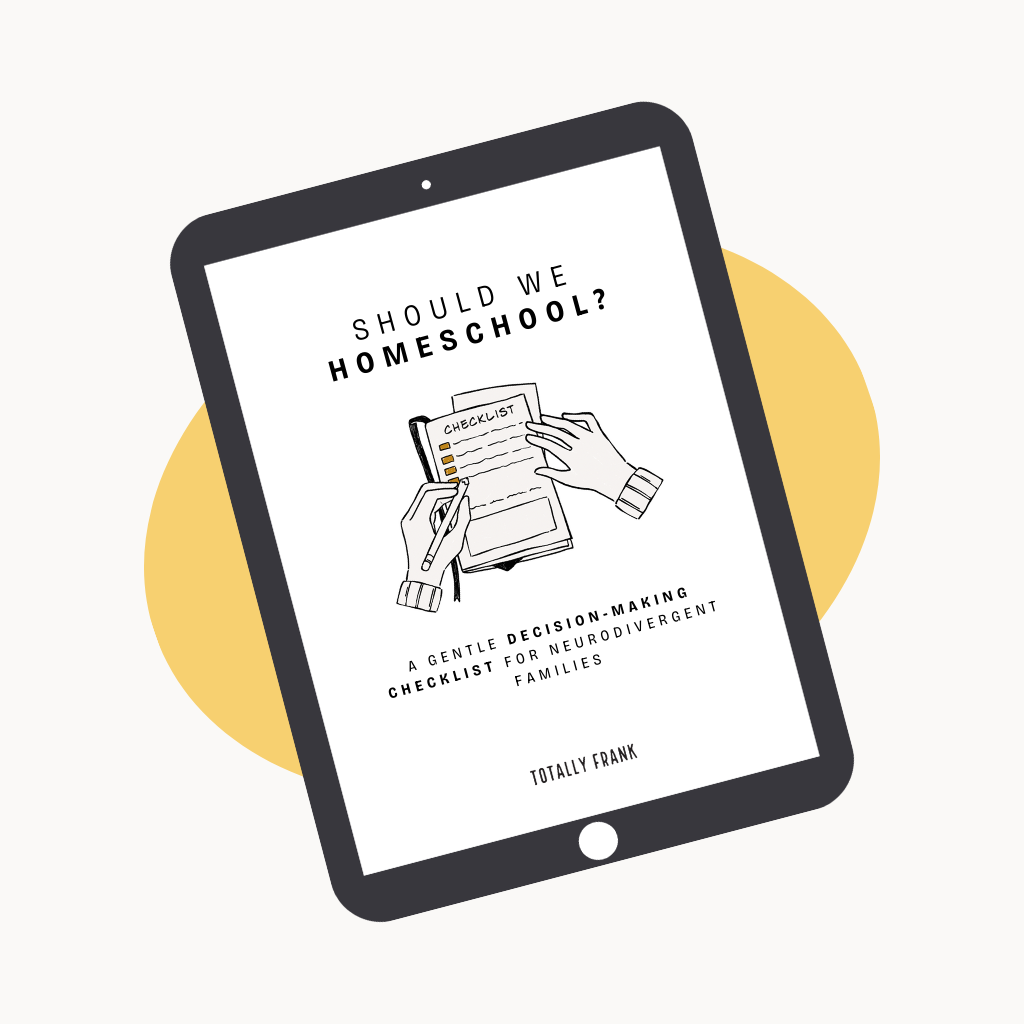
If you want help thinking this through without pressure, the Should We Homeschool? gentle decision-making checklist can guide you at your own pace.
It’s not about choosing a path straight away.
It’s about making sense of where you are.
👉 You can explore the checklist if and when it feels helpful.
Frequently asked questions
Frequently asked questions when you’re wondering if you will be doing enough homeschooling
What if I’m not qualified to homeschool my child?
You don’t need to be a teacher to support your child’s learning. What matters most is creating conditions where they can engage, explore, and build skills over time.
What if I miss something important?
Learning doesn’t happen in a fixed order. Children revisit concepts over time, often in different ways and at different stages.
Do I need a curriculum to make sure I’m doing enough homeschooling?
Not necessarily. What matters most is whether what you’re doing is working for your child – not whether it looks like school.
What if my child falls behind?
“Falling behind” is based on a standardised timeline. Many neurodivergent children don’t follow that path — and that’s okay.
What if I start homeschooling and it doesn’t work?
It doesn’t have to be permanent. You’re allowed to adjust, change direction, or reassess.
How do I know if I’m doing enough homeschooling?
Instead of measuring “enough”, it can help to notice whether your child is feeling less overwhelmed, more settled, and more able to engage over time.
Final note
You’re not being asked to get this perfect.
You’re being asked to begin.
And those are very different things.
If you’re still in the decision swirl
I send one email a week – honest reflections, gentle reframes, and lived experience from life with neurodivergent homeschoolers.
Sometimes it’s practical. Sometimes it’s just perspective. Always it’s calm and capacity-aware.