Sometimes a child who once seemed fine with school suddenly starts resisting it. When that happens with neurodivergent kids, it is often a signal that something deeper has become overwhelming.
When a neurodivergent child suddenly hates school, it’s usually a sign that something has become too heavy to carry.
Many parents recognise the moment something shifts.
A child who used to go to school begins crying in the mornings. They may complain about stomach aches, refuse to get dressed, or come home completely exhausted.
Sometimes it seems to appear out of nowhere.
Teachers may say everything seems fine at school. Friends or relatives might suggest being firmer. You might even start wondering if something at home is contributing.
It can feel confusing and frightening.
If your child hates school suddenly, it can feel like the ground has shifted under your feet.
Many parents find themselves trying to support their child while also feeling pressure to get things “back to normal”.
Often the change is not about attitude or motivation.
For many neurodivergent children, it is a sign that the demands of school have become too heavy for their nervous system to carry.
When we look at the total load school places on a neurodivergent brain, these sudden shifts often begin to make much more sense.
A Quick Summary
If you’d like a steadier voice while school feels heavy
I send one email a week – calm reflections and practical support for neurodivergent families when school is getting hard.
No pressure. No perfection. Just steadiness in the middle of it.
Looking for other parents navigating this?
If school isn’t working for your child, you’re not alone.
I run a small Facebook group for neurodivergent homeschooling families where parents share experiences, ask questions, and support each other through the messy middle.
No judgement. No pressure. Just people who understand..
Why School Can Be Harder for Neurodivergent Kids
School environments are designed around a fairly narrow range of learning styles and nervous system needs.
A typical school day requires children to:
For neurodivergent children, these tasks often require far more cognitive and emotional effort.
Executive function differences can make planning, organisation, working memory, and emotional regulation significantly harder to sustain across a full school day.
That means the same environment that feels manageable for one child may quietly exhaust another.
Over time, this effort builds.
And sometimes the nervous system eventually reaches a point where it cannot keep carrying the load.
Why It Can Seem to Come Out of Nowhere
One of the most confusing parts for parents is how sudden the change can feel.
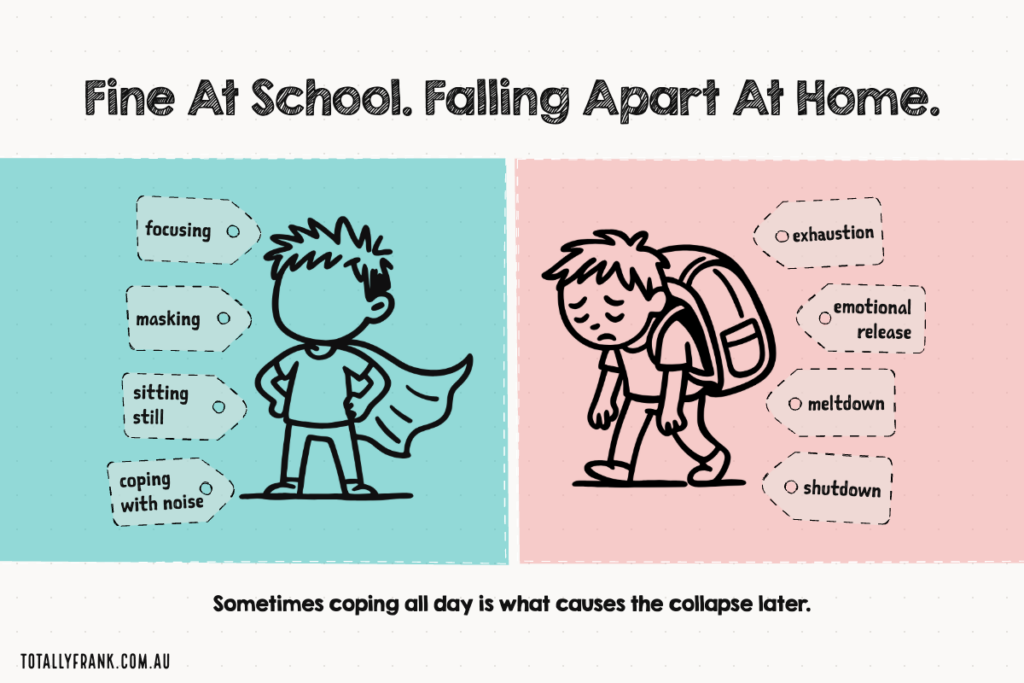
Many neurodivergent children cope quietly for a long time before reaching their limit.
They may mask their stress during the school day – holding everything together in class, following the rules, and trying hard to meet expectations.
Then the strain appears somewhere else.
Parents might notice:
This pattern is sometimes called after-school restraint collapse.
From the outside, it can look like school was working fine.
But internally, the child’s nervous system may already be overloaded.
Research into school attendance difficulties increasingly describes this pattern as school distress, recognising that emotional overwhelm – not defiance – often sits underneath attendance struggles.
Why a Neurodivergent Child Might Hate School Suddenly
School places constant demands on attention, regulation, memory, and social interpretation.
For neurodivergent children, each of those demands may require additional effort.
The total load can include:
Over time, that cumulative load can become too heavy.
When stress rises, the brain shifts away from learning and toward survival.
Neuroscience research shows that stress can significantly affect working memory, attention, and learning processes in the classroom.
When the nervous system reaches that point, resistance to school often begins to appear.
Not because a child is choosing not to learn.
But because the environment no longer feels manageable.
Signs School Is Becoming Too Much
When a child hates school suddenly, there are often earlier signs that the environment has become overwhelming.
Parents sometimes notice:
These behaviours are often misunderstood as defiance.
But many neurodivergent children are signalling that their capacity has been exceeded.
Anxiety and emotional distress among children and adolescents have increased significantly in recent years, particularly in school contexts.
Recognising these signs early can help families respond with support rather than pressure.
This Doesn’t Mean Your Child Hates Learning
One of the most important reframes for parents is this:
A child who suddenly hates school does not necessarily hate learning.
Many neurodivergent children remain deeply curious and capable learners when stress levels are lower.
The challenge is often the environment around learning, not learning itself.
Research on motivation consistently shows that students engage more when they feel a sense of autonomy, competence, and connection in their learning environment.
When those needs are not met, motivation can collapse – even in children who are naturally curious.
When Overload Turns Into Burnout
If the load continues for long enough, some children reach a deeper state of exhaustion.
This is increasingly described as autistic burnout.
Autistic burnout involves chronic exhaustion, reduced capacity to cope with everyday demands, and a loss of previously manageable skills after prolonged stress.
For children experiencing burnout, school can become impossible to manage in the way it once was.
Morning distress, shutdown, or refusal are often signs that the nervous system has reached its limit.
What Helps First When School Suddenly Becomes Hard
When school suddenly becomes hard for a child, many parents feel immediate pressure to solve it quickly.
But the most helpful first step is often to slow down.
Instead of focusing only on behaviour, it can help to ask what the nervous system is experiencing underneath the behaviour.
Sometimes this means noticing patterns such as:
Looking for patterns helps parents understand the total load, rather than reacting only to individual incidents.
It can also help to reduce pressure temporarily while you figure out what is happening.
That might mean:
For many families, the shift begins when they realise the problem is not simply behaviour.
It is that school has stopped working for their child.
If that is where things are heading, it may help to understand more about burnout and nervous system overload, what school refusal really is, and what can happen when a child refuses to go to school.
Those patterns are often connected.
And understanding them can make the next steps much clearer.
Frequently Asked Questions
Why does my neurodivergent child hate school suddenly?
When a child hates school suddenly, it is often a sign that something has become too overwhelming. That might include sensory stress, social pressure, anxiety, burnout, or the ongoing effort of coping in an environment that no longer feels manageable.
Does this mean my child is being defiant?
Not necessarily. What looks like defiance is often distress. Some children reach a point where their nervous system simply cannot keep managing the demands being placed on them.
Can a child seem fine at school and still be struggling?
Yes. Many neurodivergent children mask stress during the school day and release it at home.
What should I do first if my child suddenly does not want to go to school?
Start by slowing things down enough to understand the pattern. Look at when distress is showing up, what demands might be contributing, and whether your child is showing signs of overload, anxiety, or burnout.
Does hating school mean my child hates learning?
No. A child can struggle deeply with school and still enjoy learning. Often the problem is not learning itself, but the environment, pressure, and total load surrounding it.
When should I worry about school refusal?
If distress around school is increasing – particularly panic, shutdown, exhaustion, or persistent refusal – it is worth exploring what underlying pressures may be contributing.
If you’d like a steadier voice while school feels heavy
I send one email a week – calm reflections and practical support for neurodivergent families when school is getting hard.
No pressure. No perfection. Just steadiness in the middle of it.