When your child refuses to go to school, it can take over your whole life. This article helps you name what’s happening, reduce shame, and find calmer language for school distress – without pressure, blame, or rushing big decisions.
You’re not failing. Your child isn’t “being difficult” – they’re overwhelmed.
Some mornings, it’s not a gentle “come on, let’s go”.
It’s a child who won’t get out of bed. Or won’t put the uniform on. Or refuses to get out of the car – even when you’ve organised special hours to avoid the rush. And suddenly, school refusal becomes the centre of everything.
This is the part nobody prepares you for: the constant fear that your child is missing out, falling behind, or being labelled as “difficult” – while you’re doing everything you can just to get through the morning. It can feel soul-destroying. Not because you don’t care, but because you care so much – and the pressure keeps piling on.
If you’re in the thick of it, you might recognise this:
You’re not alone in this. And you’re not failing.
In our house, both our boys were in primary school and really struggling – refusing to go, or we’d get called to pick one of them up early after another “incident”. It got so bad that every time the phone rang, my husband and I would literally jump.
The school leadership wasn’t supportive, and one day – after another incident where my son ran away from school – I was completely and utterly spent. We had no support, and it was beyond overwhelming.
This page won’t tell you to “just be consistent” or push through.
Instead, it will help you:
A Quick Summary
“School refusal” is a label people use when a child won’t attend.
“School can’t” is what it means when a child can’t – because their nervous system has hit its limit.
The difference matters, because it changes what helps.
Often:
If you’d like a steadier voice while school feels heavy
I send one email a week – calm reflections and practical support for neurodivergent families when school is getting hard.
No pressure. No perfection. Just steadiness in the middle of it.
When It Stops Being “A Rough Patch”
A lot of parents don’t arrive here after one bad day. They arrive after months (sometimes years) of signs that school is becoming harder to tolerate.
When a child refuses to go to school it can look like:
For many neurodivergent kids, this pattern fits better under school distress than “behaviour problems”.
That doesn’t mean it’s easy. It just means you’re not imagining it.
The Word “Refusal” Can Be The Problem
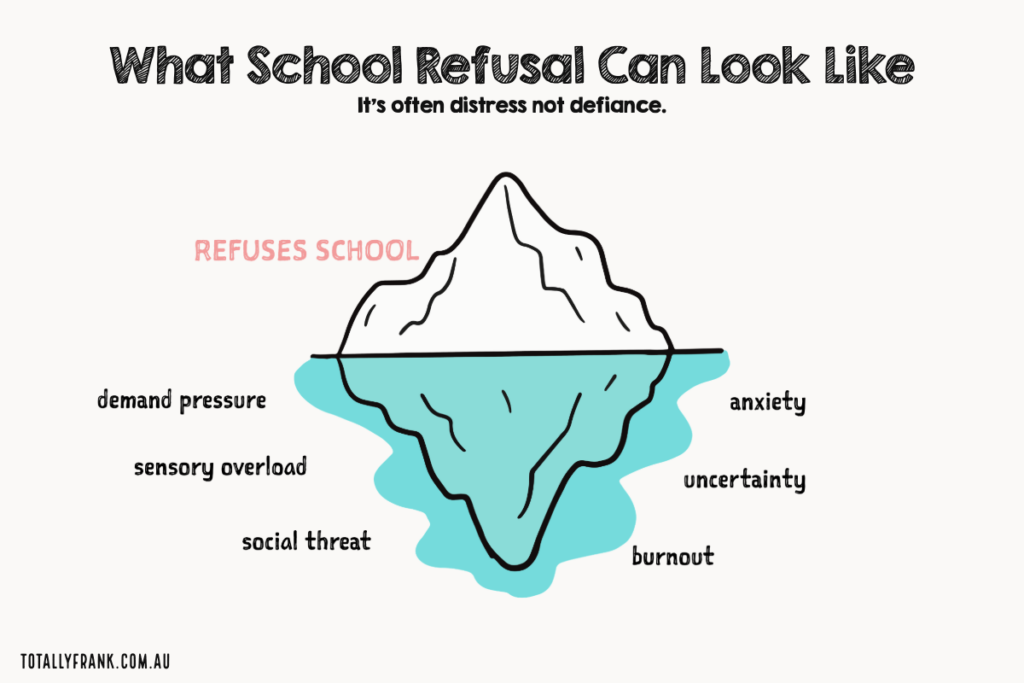
“Refusal” sounds like choice. It can make it sound like your child is being stubborn, manipulative, or trying to “get their own way”. But when a child is panicking, shutting down, vomiting, shaking, freezing, or bolting – that’s not a negotiation. That’s distress. And language matters, because the word we choose often shapes the response we get.
A phrase you can borrow (if it helps):
“My child isn’t giving me a hard time – they’re having a hard time.”
What’s Usually Underneath School Refusal
When a child refuses to go to school there usually isn’t one single cause. Most families are dealing with one thing… or a pile of things.
Here are some of the common “underneath” layers for autistic, ADHD, PDA and anxious kids:
Sensory Overload
School is a sensory obstacle course:
Social Threat Load
Even a “nice” school day can be socially exhausting:
Demand pressure and loss of control
Some kids cope until their nervous system hits a limit – then even small demands feel unbearable.
If your child has demand avoidance patterns, it can help to hold this lightly and carefully: the research base is still developing and contested, so we use the language to understand, not to box kids in.
Uncertainty And Transitions
A new building. New expectations. New teachers. New routines.
School can be a perfect storm of uncertainty: sensory overload, new social hierarchies, different rules, and a day that feels less predictable.
Burnout and chronic stress
Sometimes when a child refuses to go to school it’s the final sign that they have been coping for too long. Parents often describe it as: “They were holding it together… until they just couldn’t.”
Research exploring autistic children’s educational experiences (including those with demand avoidance behaviours) reflects how school environments can become a poor fit when stress and unmet needs pile up.
Why pressure often makes it worse
When a nervous system is in threat mode, skills go offline.
That can mean:
This is why so many parents say, “Nothing works.”
A trauma-informed lens in education highlights the role of safety, relationship and nervous system readiness in learning and behaviour.
Not because parents aren’t trying hard enough – but because pressure doesn’t create safety.
What This Does To Parents
When a child refuses to go to school it doesn’t just affect the child. It affects the whole family system.
You might recognise this:
If you feel like you want to tap out sometimes, it doesn’t mean you don’t love your child.
It means you’re exhausted.
“If This Is You, You’re Not Alone” (voices from other parents)
Sometimes the most regulating thing is realising: other families are living this too.
“My almost 15 year old won’t go to school… I am at a total loss… I feel like the biggest failure… The stress… is having a substantial impact on my marriage. I want to tap out.”
Source
If this is you, you’re not weak – you’re carrying something genuinely heavy.
“My 8yo is displaying a lot of anxiety along with ADHD… therapist suggested we don’t make him go… This goes against everything I’ve been taught about avoidance and anxiety.”
Source
It makes sense to feel torn when your instincts say “protect” and the world says “push”.
“Just had to literally wrestle my PDA AuDhD 10yo down to school… I feel like such a rat… I’m terrified I’m harming him… we have absolutely zero alternatives.”
Source
If you’ve reached physical force, that’s a sign the system is out of alignment – not proof you’re a bad parent.
The “middle place” many families get stuck in
A lot of families don’t move neatly from “attending” to “not attending”.
They end up in limbo:
Limbo is still a place. And it still counts as survival.
What Helps Right Now (without making it a battle)
This isn’t a step-by-step plan. It’s a list of small options you can hold gently – and use only what fits your family’s capacity.
Lower the temperature of the morning
Protect the relationship
Even if school is falling apart, your connection matters. For many kids, relationship is the bridge back to safety.
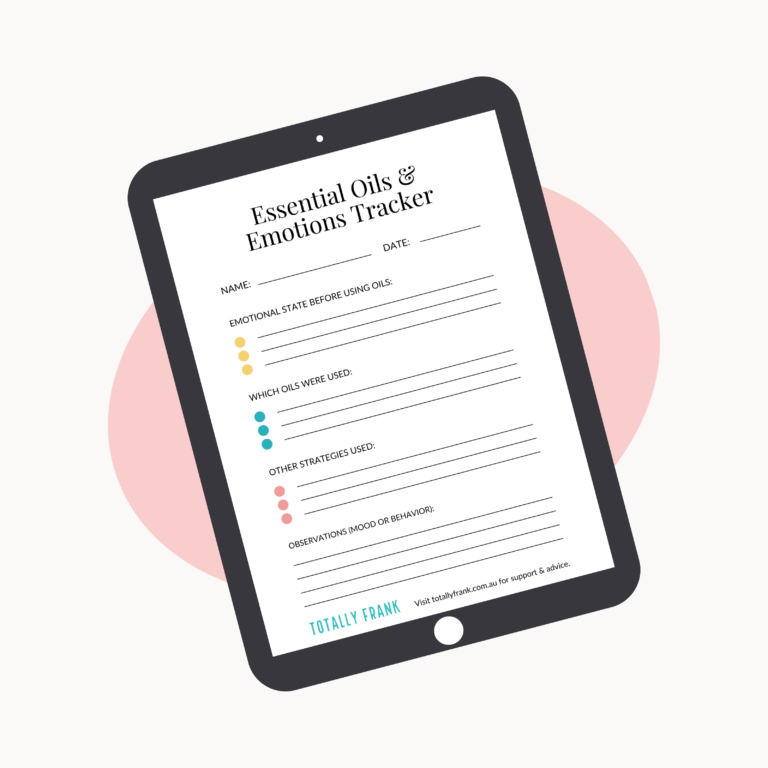
Track Patterns Gently (For Advocacy, Not proof)
Not to build a case against your child.
To notice:
Choose one support pathway to prioritise this week
Just one.
School contact, GP, therapist, OT or a rest and recovery plan.
You don’t need to solve the whole future while you’re surviving the present.
If you’re not sure what to do next, take a pause first
If everything feels urgent and loud right now, you don’t need to decide anything today.
Frequently Asked Questions
Is school refusal the same as school anxiety?
Sometimes they overlap. Anxiety can be part of it, but school refusal can also be driven by sensory overload, social threat, burnout, and unmet needs.
What’s the difference between “school refusal” and “school distress”?
Many researchers use “school distress” to describe severe emotional distress around attendance, which can shift the lens away from blame and towards support.
Why does my child seem fine at home but fall apart about school?
Home is predictable. School is demanding and sensory/socially intense. Some kids can hold it together until they hit safety – then the collapse happens.
Can autistic burnout show up as school refusal?
It can. Burnout often shows up as reduced tolerance, reduced capacity, and a nervous system that can’t keep pushing through.
What if the school says my child is manipulating me?
You’re allowed to disagree with that framing. You can keep returning to: “This is distress. We’re trying to reduce overload and increase safety.”
Should I force my child to attend?
There isn’t one right answer. Many families try force because they’re out of alternatives. If force is escalating fear, it’s usually a sign the current plan needs review and more support.
How do I talk to the school without escalating things?
Bring language that focuses on needs and safety, not blame. Short, factual, calm.
What if we’ve tried everything and nothing is working?
Then you’re in the hardest part – and you deserve more support than “try harder”. It may be time to slow down and look at the environment, capacity, and safety factors first.