Sometimes the first signs that school is becoming difficult for a child are easy to miss. A child may still be attending, still getting through the day, and still quietly showing you that something is becoming too much.
Struggling In School Often Start Long Before A Child Refuses School
Many parents notice small changes first.
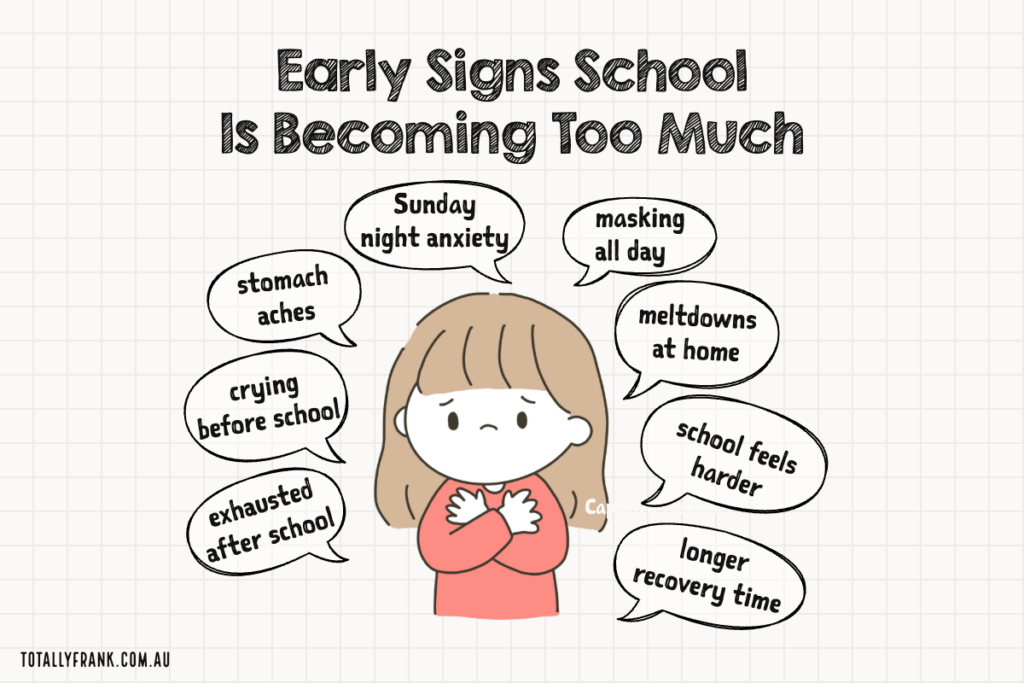
A child who used to go to school without much trouble begins complaining of stomach aches in the morning. They may start crying before school, taking longer to get dressed, or coming home exhausted.
Sometimes the changes seem small at first.
Because the child is still attending school, adults often assume things are mostly fine.
Teachers may report that the child is coping in class. From the outside, it can look like school is working.
But something still feels off.
Parents often notice the early signs before anyone else does.
You might see the exhaustion after school, the Sunday night anxiety, or the growing resistance in the mornings.
It can be hard to know whether these changes are normal or something deeper.
Often, these early signs are the first signals that the school environment is becoming overwhelming for your child’s nervous system.
School distress rarely appears suddenly.
For many children, it builds quietly over time before it becomes impossible to ignore.
A Quick Summary
If you’d like a steadier voice while school feels heavy
I send one email a week – calm reflections and practical support for neurodivergent families when school is getting hard.
No pressure. No perfection. Just steadiness in the middle of it.
Why the Early Signs Are Easy to Miss
One reason early school struggles can be hard to recognise is that many children keep going to school even when it is becoming difficult.
Attendance alone does not tell the full story.
A child may still be managing to sit in class, complete work, and follow instructions while their nervous system is already under significant strain.
Research into school attendance patterns increasingly describes school distress as a key factor in non-attendance. These patterns are often linked with anxiety, sensory overwhelm, and emotional strain rather than simple refusal or defiance.
Because distress can build gradually, the first signs often appear outside the classroom.
Parents may notice them long before the school does.
Common Early Signs Your Child Is Struggling in School
Early signs of a child struggling at school often show up in everyday moments.
Some children begin to show increasing anxiety around school routines. Others become exhausted or emotionally overwhelmed after the school day.
Parents often notice patterns such as:
These behaviours can sometimes be misunderstood as defiance or reluctance.
But many children are actually signalling that the demands of school are becoming too much to sustain.
Studies across multiple countries show that anxiety and emotional distress among children and adolescents have increased significantly in recent years, particularly around school-related pressures.
When children start showing these patterns, it can be helpful to look beyond behaviour and consider the overall load they may be carrying.
Why Some Children Seem Fine at School but Fall Apart at Home
One of the most confusing patterns for parents is when a child appears to cope at school but collapses afterwards.
This can happen because many children spend the school day working very hard to hold everything together.
They may focus intensely, follow rules carefully, suppress emotional reactions, and try to meet expectations even when they are overwhelmed.
When the school day ends, the nervous system finally releases that pressure.
This is sometimes called after-school restraint collapse.
At home, parents may see:
This does not mean school is going well.
In many cases, it means the child has been using most of their available energy simply to get through the day.
Neuroscience research shows that stress can significantly affect working memory, attention, and the brain systems involved in learning and emotional regulation.
When a child’s brain is under constant stress, the effort required to keep coping increases over time.
Why Neurodivergent Kids Often Reach This Point Sooner
For neurodivergent children, school environments can require significantly more effort to navigate.
A typical school day involves:
Executive function skills – including planning, working memory, organisation, and emotional regulation – are heavily involved in these tasks.
For children with differences in executive functioning, maintaining these skills across a full school day can be exhausting.
Many neurodivergent children are also managing additional layers of effort, such as:
Over time, these demands can accumulate.
Eventually the nervous system reaches a point where coping becomes much harder.
When a child begins showing early signs of distress around school, it is often a signal that their current environment or expectations are exceeding their available capacity.
This does not necessarily mean the child dislikes learning.
Instead, it may mean that the overall demands of school – academic, social, sensory, and emotional – have become too heavy.
Some researchers now describe these patterns using the concept of “school can’t”, which recognises that attendance difficulties are often linked to reduced capacity rather than unwillingness.
When capacity is exceeded, children may begin to show signs of:
Recognising these patterns early can help families respond with support rather than pressure.
What Helps First
When parents begin noticing these early signs of struggling in school, the most helpful first step is often to slow down and observe patterns.
Instead of focusing only on the behaviour itself, it can help to ask what the child’s nervous system may be experiencing.
Helpful first steps may include:
For some children, these signs may be early indicators of deeper exhaustion or burnout.
Recent research increasingly recognises autistic burnout as a state of chronic exhaustion and reduced capacity caused by prolonged stress and unmet support needs.
Understanding these early signals can help families respond sooner, before distress becomes more severe.
If you are seeing these patterns, it may help to explore what happens when school stops working for a child, how burnout and nervous system overload develop, and what researchers mean when they describe school distress.
These ideas can offer a clearer framework for understanding what your child may be experiencing.
Frequently Asked Questions
What are the first signs a child is struggling in school?
Early signs can include anxiety before school, physical complaints like stomach aches, exhaustion after school, emotional meltdowns at home, and increasing resistance to school routines.
Why does my child seem fine at school but fall apart at home?
Many children use a lot of energy coping at school. When they get home to a safe environment, their nervous system finally releases the pressure they have been holding in all day.
Does struggling in school mean my child hates learning?
Not necessarily. Many children who struggle with school environments still enjoy learning when stress levels are lower and the environment feels safer.
Can anxiety cause children to avoid school?
Yes. Anxiety and emotional overload are common contributors to school distress and school attendance difficulties.
When should I worry about my child struggling in school
If distress is increasing, your child is becoming exhausted or anxious around school, or mornings are becoming increasingly difficult, it is worth taking those signals seriously.
If you’d like a steadier voice while Your Child Is Struggling In School
I send one email a week – calm reflections and practical support for neurodivergent families when school is getting hard.
No pressure. No perfection. Just steadiness in the middle of it.