A calm starting point if you’re considering homeschooling an autistic child and you’re stuck in the “Can I actually do this?” loop. We’ll cover what matters first (safety, capacity, flexibility), what homeschooling can look like, and how to begin without turning your home into school.
A calm starting point if you’re seriously considering homeschooling
If you’re here, there’s a good chance you’ve moved past the casual “maybe one day” thoughts – and into the real, weighty ones.
The ones that sound like:
And meanwhile, the world around you is still talking like the only reasonable option is to keep pushing through… even when your child is clearly running out of capacity.
That mismatch can make you feel wobbly.
Not because you’re dramatic – but because you’re trying to make a big decision inside a system that rarely makes space for nervous system reality.
I’ve been that parent – standing in the gap between what school expects and what a neurodivergent child can actually sustain – trying to hold the line while also protecting the kid in front of me.
So let’s start with something steadier:
For many autistic kids, learning doesn’t fall apart because they’re “not trying”.
It falls apart because the load has finally outweighed capacity – and the body starts protecting itself. When things don’t feel safe (sensory-wise, socially, emotionally), even simple tasks can start to feel impossible.
This page is here to help you look at homeschooling through a calmer lens.
Not as a perfect plan you have to commit to today.
But as a legitimate option you’re allowed to explore – with safety, flexibility, and your capacity at the centre.
A Quick Summary
Homeschooling an autistic child doesn’t have to mean recreating school at home.
For many families, it’s a way to reduce pressure and increase safety – so learning becomes more possible again.
Homeschooling can help because it allows for:
You don’t need to feel 100% sure before you begin exploring.
You just need a clearer lens – and a next step that doesn’t tip you into overwhelm.
If you’re still in the decision swirl
If You’re Asking “Am I Capable?” – Start Here
This question is so common. And it makes sense.
Because what you’re really asking is usually something like:
So here’s a reframe that helps:
You don’t need to be a teacher.
You need to be someone who can build a safer learning environment than the one that’s currently breaking your child down.
That’s it.
You’re not recreating school – you’re creating conditions
School is built around:
Home can be built around:
And that’s why homeschooling can work so well for some autistic kids.
Not because home is magical.
But because the “learning conditions” are adjustable.
A “capability check” that won’t shame you
Not a test. Just a way to find your next step.
Ask yourself:
If you can answer those questions gently, you’re already doing the job.
A permission line you might need today
You’re allowed to try homeschooling without having the rest of your life perfectly sorted.
You’re allowed to start small.
You’re allowed to adapt.
Why autistic homeschool can be a better fit (for some families)
I’ll say this clearly: homeschooling isn’t the right fit for everyone.
But it can be a better fit for some autistic kids because it lets you change the variables that school often can’t change.
1) Flexibility (the underrated superpower)
Homeschooling can mean:
Flexibility isn’t “spoiling”.
It’s how you protect capacity.
2) Customisable learning
Autistic kids often have very specific learning needs:
At home you can adjust:
That customisation can be the difference between “impossible” and “possible”.
3) Safety (emotional + sensory)
When your child’s nervous system feels unsafe, learning becomes expensive.
Even if the worksheet is easy.
Even if they’re bright.
Even if they “could do it yesterday”.
Homeschooling an autistic child often works best when you treat safety as the foundation:
Not perfect. Just safer.
What homeschooling can look like (so you’re not guessing)
One of the most stressful parts of considering homeschooling is the blank space.
People say “homeschool” and you think:
Here are three common “starter styles”. You can mix them, and you can change later.
Style 1: Semi-structured (my favourite place to start)
It gives enough shape to feel steady, without becoming rigid.
Style 2: Structured (if your child needs predictability)
This can work beautifully for some kids – especially if the structure feels safe, not controlling.
Style 3: Interest-led (if demands are a big issue)
This can be a game-changer when school refusal, burnout, or demand sensitivity is in the picture.
Key point: you don’t have to choose the “forever style” today. You can start with what’s survivable.
Curriculum (keep it simple here)
If you’re prone to spiralling (hello, same), curriculum is where it happens.
Because curriculum feels like certainty.
But it can also become a trap.
So we’re going to keep this calm and basic.
Start with “minimal viable learning”
Especially early on, especially after stress.
Think:
You can build from there.
A calm curriculum filter (use this before you buy anything)
Ask:
If it creates daily conflict, it’s not “discipline you need”.
It’s feedback.
Quick overview of options (no deep dive)
I’ll write a dedicated curriculum page later. For now, the goal is: don’t make curriculum the first thing you solve.
Interest-based learning (and why special interests count)
This is where a lot of parents need permission.
Because so many of us were taught that “real learning” looks like:
But autistic kids often learn best when:
Special interests aren’t a distraction. They’re often the doorway.
A simple method: Anchor + Extend
This keeps interest-based learning practical (and stops it feeling like “we’re doing nothing”).
Examples:
The stretch should be small enough that it doesn’t trigger shutdown.
You’re not trying to “make it educational”.
It already is.
You’re just making the learning visible.
What research suggests (in plain English)
Here’s the basic theme across motivation research:
When people (including kids) feel:
their motivation tends to be healthier and more sustainable.
Not “bribed into compliance”.
More like: I can do this, it matters to me, and I’m safe enough to try.
A large body of research on Self-Determination Theory backs this general pattern.
There’s also some homeschool-specific research suggesting home education is often linked with higher learning motivation and engagement than conventional schooling, especially when learning is flexible and individualised. That doesn’t mean homeschooling is “better for everyone” – it’s just one piece of information that matches what many families report.
And one small study of young adults found home-educated participants reported higher feelings of autonomy and competence than traditionally schooled peers, while connection/relatedness was similar in both groups. Again: useful signal, not a universal promise.
The reason I include this at all is simple:
You’re not imagining that conditions matter.
They do.
A gentle first month plan (so you can start without panic)
Weeks 1-2: Recovery + Rhythm
Focus:
Anchors can be as small as:
Weeks 3: Add Light Structure (Only If It Feels safe)
Add:
Week 4: Review and Adjust
You’re not failing if you change the plan.
You’re responding to real data.
Common worries (that don’t mean you’re doing it wrong)
“What About Socialisation?”
Connection matters. But it doesn’t have to be 30 kids in a room all day.
Social can be:
Start with safety. Social grows better from there.
“What if I mess it up?”
You will make mistakes.
So will schools.
The difference at home is you can repair quickly.
You can change direction without bureaucracy.
You can say: “That didn’t work – let’s try something else.”
That’s not failing. That’s responsive parenting.
“What if my child refuses learning at home too?”
That’s usually information, not defiance.
It can mean:
Start with safety, rhythm, and interest. Then build outward.
“How many hours a day should we do?”
As few as needed to stay regulated and consistent.
More hours doesn’t equal more learning – especially when stress is high.
Start small. Let success build capacity.
Frequently Asked Questions
Can you homeschool an autistic child successfully?
Many families do. The biggest lever is often whether you can build an approach that protects safety, capacity, and connection – not whether you can replicate school.
Do I need teaching qualifications to homeschool an autistic child?
No. What matters most is your ability to create supportive learning conditions and adjust as you go.
What’s the best curriculum for an autistic homeschool?
The best curriculum is the one that your child can engage with consistently without it costing their nervous system. Start small and adjust.
Is interest-based learning enough?
For many autistic kids, interest-based learning is a powerful engine – especially early on. You can scaffold skills inside interests over time.
How do I start if my child is burnt out from school?
Start with recovery and rhythm. Reduce demands. Protect safety. Let learning re-enter through interest and connection.
How many hours a day should we do?
There’s no universal number. Start with what’s sustainable. Consistency beats intensity.
What about friends and social skills?
Connection matters. It doesn’t have to look like school. Start with safe, low-pressure social options that respect your child’s sensory and recovery needs.
What if we start homeschooling and it doesn’t work?
You’re allowed to reassess. You can adjust style, supports, pace, and structure – and you can choose a different option later if needed.
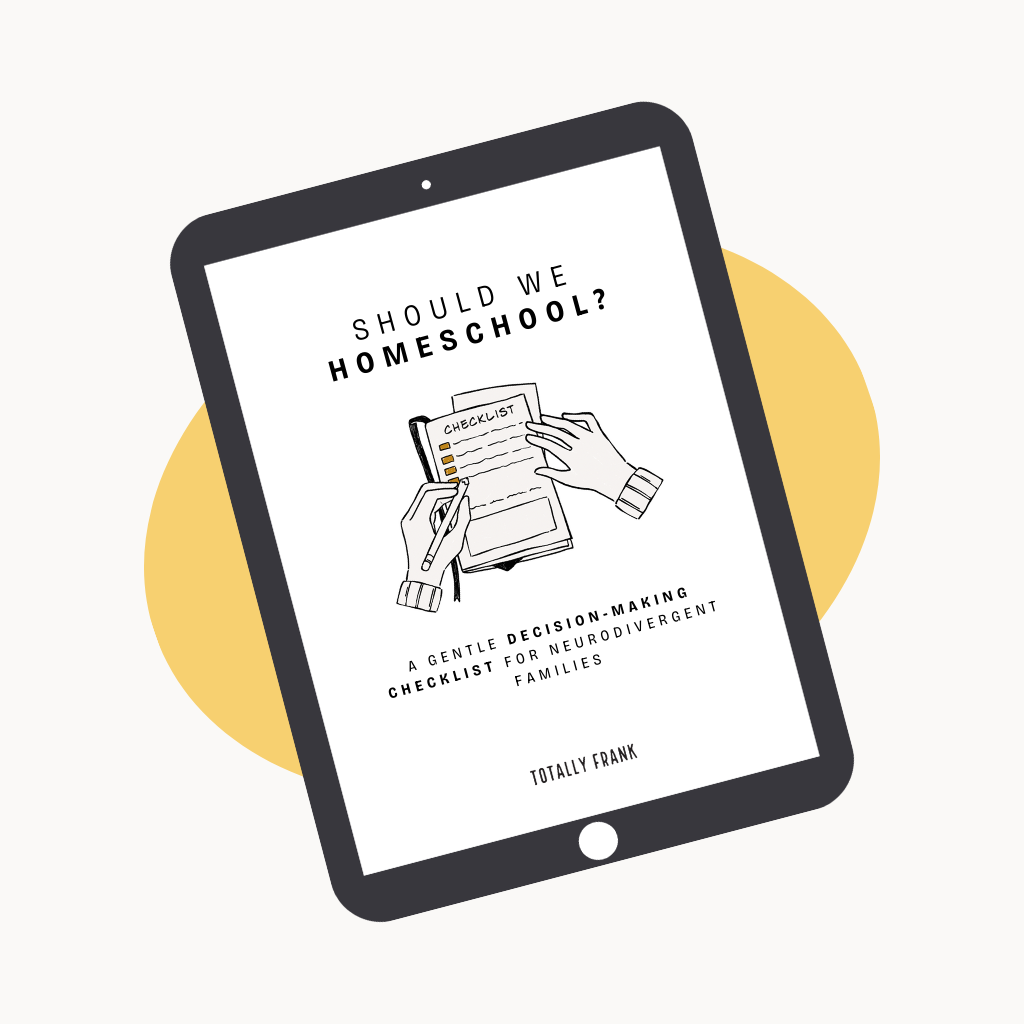
A free checklist to help you sort fear from facts and find your “yes / no / not yet” — without pressure.
If you’d like a steadier voice while you’re building homeschool
I send one email a week – honest reflections, gentle reframes, and lived experience from life with neurodivergent homeschoolers.
Sometimes it’s practical. Sometimes it’s just perspective. Always it’s calm and capacity-aware.