Neurodivergent burnout in kids can look like anxiety, shutdowns, and a child who suddenly can’t do what they used to. This guide helps you understand the overload – and support recovery in a pressure-off way.
How to tell when your child is running on empty – and what helps
When “Hard But Doable” Becomes Impossible
If you’re starting to feel like everything is a fight – mornings, school, transitions, basic tasks – and your child seems more distressed than they used to be, it makes sense that you’re worried.
When neurodivergent kids are overloaded, their nervous system doesn’t politely send a warning email. It sends a full-body message: “I can’t.”
The hard part is that this often gets misunderstood. People look for discipline problems, motivation problems, parenting problems… while you’re watching a child who is genuinely out of resources.
I’ve been in that space – holding everyone else’s expectations while trying to protect a child who was clearly running on empty.
This page is here to help you name what might be happening – neurodivergent burnout, anxiety, nervous system overload – and to offer a pressure-off path toward recovery.
Because your child isn’t “too much”.
And you’re not failing.
A Quick Summary
When a neurodivergent child is in burnout, anxiety and “refusal” are often the surface – the deeper issue is that their nervous system has run out of capacity.
This can happen when:
What helps most isn’t more motivation or firmer routines.
It’s a pressure-off approach:
You don’t have to solve schooling today. You just need a clearer explanation for what you’re seeing – so you can respond with support, not panic.
If you’d like a steadier voice while school feels heavy
I send one email a week – calm reflections and practical support for neurodivergent families when school is getting hard.
No pressure. No perfection. Just steadiness in the middle of it.
What Is Neurodivergent Burnout in Kids?
“Burnout” is often talked about in adults, but families recognise the pattern in kids too: long-term overload, reduced capacity, and a nervous system that can’t keep up anymore.
In autism research, burnout is commonly described as debilitating exhaustion with reduced capacity and a bigger day-to-day “impact footprint” (more things feel hard, more easily).
Another evidence-backed way to understand it is long-term capacity overload – when demands keep exceeding resources and recovery.
For kids, this can show up as:
A really important note: burnout isn’t a failure of character.
It’s a nervous system doing its job: protecting.
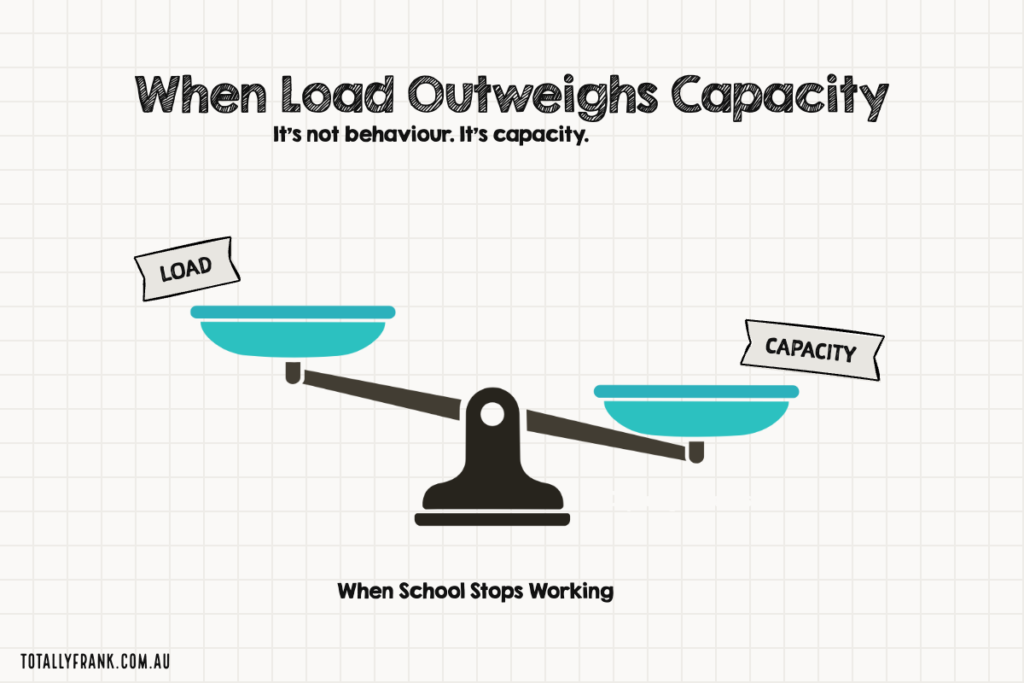
Burnout, Anxiety, and Nervous System Overload: How They Fit Together
These three often travel together, and they can be hard to separate in real life.
Nervous system overload
This is the body’s “too much” alarm.
Anxiety
Anxiety is often what we see first.
It can look like:
But anxiety can be the surface layer of a deeper reality: the nervous system is already overloaded.
Burnout
Burnout is what can happen when overload stays high for too long:
This is why a pressure-only approach usually backfires. If the nervous system is already overloaded, adding pressure can increase distress rather than improve functioning.
Signs Your Child Might Be Running On Empty
Here are some common “running on empty” signs in neurodivergent kids. You don’t need to tick every box for this to be real.
You might notice:
A steady way to frame it is this:
Your child isn’t “not trying”.
Your child is out of resources.
Why School Can Tip Neurodivergent Kids Into Overload
School isn’t one environment – it’s thousands of small demands stacked together.
Even when the teachers are kind, even when your child is bright, even when they “seem fine”:
And if your child has been coping for a long time, the crash can look sudden.
But it’s usually the end of a long stretch of over-coping.
This is one reason the “school-can’t” lens matters. For many kids, this isn’t refusal – it’s capacity. They can’t get to school, even if they want to.
What Helps (Without Turning Home Into Another Pressure Zone)
Here’s the pressure-off, nervous-system-first approach.
Not because it’s trendy.
Because it aligns with how brains and bodies actually work under stress.
1) Start with safety, not compliance
If a child doesn’t feel safe enough, their brain is busy protecting them – and it’s much harder to learn.
This might mean:
2) Reduce load before you add strategies
When families are desperate, it’s so normal to start adding:
But if capacity is already exceeded, adding more can be like stacking boxes on an already-cracked shelf.
A better first move is load reduction:
3) Support regulation in small, proactive ways
Small, proactive regulation supports – like short breaks and predictable routines – can make a classroom (or home) feel more workable.
At home, that might look like:
4) Rebuild resources (recovery is not optional)’
In autistic burnout research, recovery tends to look less like “pushing through” and more like reducing load, rest, sensory relief, solitude, and real support.
Another model frames support and accommodations as “resources” that reduce strain and help prevent a loss spiral.
You can translate that into kid-life like:
This isn’t “letting things slide”.
It’s nervous system care.
If You’re Stuck In The School Question
You don’t have to decide schooling today to support recovery today.
If you’re in the “school has stopped working” zone, these pages may help you find language and options:
Frequently Asked Questions
Is this just anxiety?
Sometimes anxiety is the headline. But anxiety can also be the nervous system’s alarm bell for overload. If reducing load helps more than reassurance, you’re probably looking at capacity, not just worry.
Can a child burn out?
Research on autistic burnout is often focused on autistic people broadly (frequently adults), but the core mechanism – long-term overload and reduced capacity – maps closely to what many families observe in kids.
What if the school keeps saying we have to push attendance?
You can acknowledge the system’s needs while still honouring your child’s capacity. The “school-can’t” framing supports a wider lens: environment, relationships, and stressors – not just the child’s behaviour.
What’s the first thing I should do?
Pick one load-reducer you can implement today. Not ten.
One tiny pressure-off change is often more effective than a big new plan.
When should we seek professional support?
If your child is unsafe, deteriorating rapidly, or you’re carrying this alone, it’s ok to ask for help. You deserve support as much as your child does.
Gentle Next Step
If you’re in the “everything is too much” season, you don’t need a perfect plan.
You need a calmer next step.
If school has stopped working and you’re considering homeschooling or deschooling, you might like Deschooling Essentials (free mini guide) – a pressure-off starting point for families in survival mode.