When a child begins experiencing school distress, parents are often given advice that sounds sensible and practical. But some of the most common responses can unintentionally make school distress worse.
Common Responses That Can Make School Distress Worse
When school distress first appears, most parents are simply trying to solve a problem quickly.
You may be told to push through the resistance, introduce consequences, remove privileges, or use reward charts to motivate your child.
Schools often recommend behaviour plans designed to increase attendance. On the surface, these strategies seem logical.
But when a child is already overwhelmed, they often don’t help.
In many families, they actually make school distress more intense.
Mornings become harder.
Anxiety increases.
Meltdowns become more frequent.
Getting to school feels more and more impossible.
When this happens, many parents begin questioning themselves.
You might wonder if you’re being too soft, not consistent enough, or somehow making the situation worse.
But in many cases, the problem isn’t motivation or behaviour.
It’s that the child’s nervous system is already overwhelmed.
When a child’s capacity has been exceeded, strategies designed to increase compliance can unintentionally increase distress.
Understanding that difference changes how we respond.
A Quick Summary
If you’d like a steadier voice while school feels heavy
I send one email a week – calm reflections and practical support for neurodivergent families when school is getting hard.
No pressure. No perfection. Just steadiness in the middle of it.
What Is School Distress?
School distress describes the intense emotional and nervous system response some children experience in relation to school.
For many children – particularly neurodivergent children – the demands of the school environment can become overwhelming. Anxiety, sensory overload, social pressure, academic demands, and exhaustion can accumulate until the child’s capacity is exceeded.
When this happens, school may trigger distress rather than learning.
This is why some children appear to resist school, shut down, or become unable to attend.
Many researchers now describe this pattern as school distress or school attendance difficulties, recognising that the issue is often capacity and overwhelm rather than behaviour.
Why Pushing Harder Often Makes School Distress Worse for Children
When a child struggles with school, the instinct to push harder is very understandable.
Parents want to help their child keep going. Schools want to prevent absences from becoming a pattern. Everyone hopes that if the child can just get through the day, things will settle again.
But when distress is driven by overwhelm, pushing harder often has the opposite effect.
When a child feels trapped in a situation that their nervous system experiences as threatening, the brain shifts into survival mode. Learning becomes much harder, and the urge to escape the situation becomes stronger.
Research shows that stress can significantly affect attention, working memory, and the brain systems needed for learning and regulation. This means that increasing pressure can actually reduce the child’s ability to cope.
For many families, the turning point comes when they realise the problem is not motivation.
It is that the child’s capacity has been exceeded.
Why Common Advice Can Make School Distress Worse
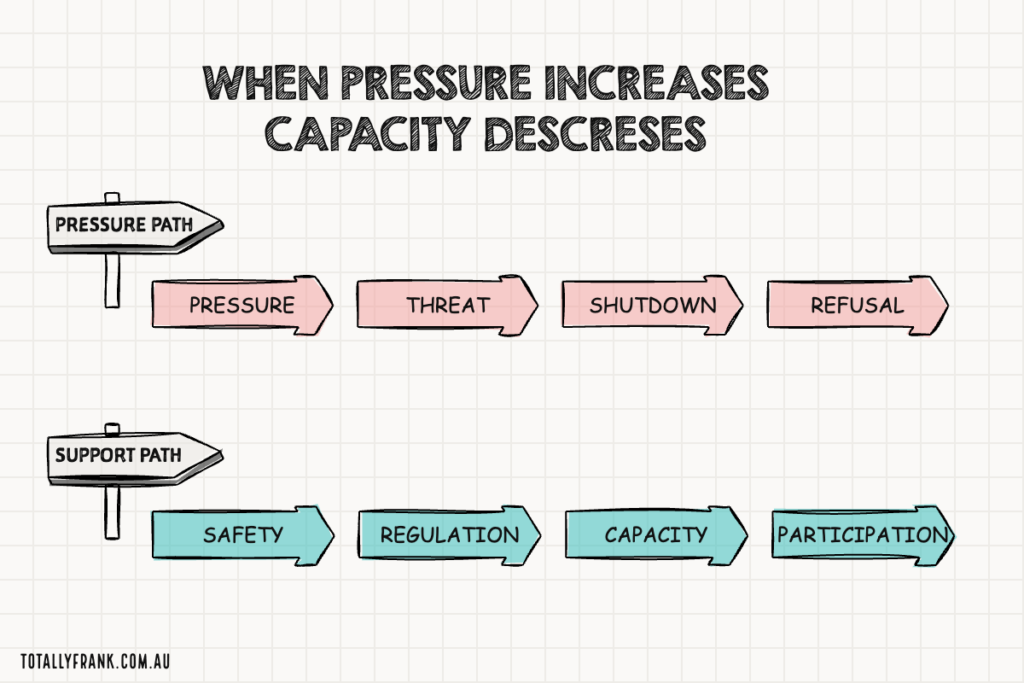
School distress usually appears when the total load of school exceeds a child’s capacity.
When a child struggles with school, most advice assumes that the problem is behaviour. The assumption is that the child could attend school if they were motivated enough.
From that perspective, solutions often focus on increasing motivation or consequences. But many children who struggle with school are not lacking motivation.
They are experiencing overload.
Stress can change how kids pay attention and learn, making it significantly harder for a child to cope in demanding environments.
When the nervous system is already under pressure, increasing external pressure rarely helps.
Instead, it often escalates the threat response.
What Makes School Distress Worse
When a child is experiencing school distress, many of the responses adults try first are designed to increase effort, motivation, or compliance.
On the surface, these approaches make sense.
Parents want to help their child keep going. Schools want to prevent absence becoming a pattern.
But when a child’s nervous system is already overwhelmed, increasing pressure often has the opposite effect.
Instead of increasing a child’s capacity to cope, it can intensify the sense of threat their brain is already experiencing.
Several common responses tend to make school distress worse.
Pushing Through the Distress
Many children are encouraged to just get through the day.
Sometimes this works briefly. But when distress is caused by overload, pushing through can increase exhaustion and anxiety over time.
A child who is already near their limit may begin associating school with pressure and survival rather than learning.
Introducing Consequences
Removing privileges or increasing consequences is often suggested when attendance becomes difficult.
These approaches assume the child has the capacity to attend but is choosing not to.
When the underlying issue is overwhelm, consequences rarely increase capacity.
They often increase stress instead.
Using Reward Charts or Incentives
Reward systems are designed to increase motivation.
They can work when a child is capable of completing a task but needs encouragement.
But when school distress is driven by overload or anxiety, the issue is not motivation.
The issue is capacity.
No reward can make an overwhelmed nervous system feel safe.
Forcing Attendance at Any Cost
When school attendance becomes uncertain, families can feel intense pressure to ensure their child keeps going.
This pressure may come from schools, policies, or well-meaning advice.
But forcing attendance while distress is escalating can sometimes deepen anxiety and prolong recovery.
For some children, repeated exposure to an overwhelming environment can lead to burnout rather than resilience.
When school distress continues to escalate, it can help to understand the difference between school refusal and school-can’t.
What Parents Often Try First
When school suddenly becomes difficult, most parents respond in ways that make sense at the time.
You might try encouraging your child to push through the day. You might introduce consequences for not attending, remove privileges, or create reward charts to motivate them.
Schools may suggest behaviour plans designed to increase attendance.
None of these responses come from bad parenting. They are the strategies most families are told to try first.
But when a child is already overwhelmed, these approaches can unintentionally increase the pressure the child is experiencing.
Understanding why that happens can help parents respond differently.
What Not To Do When School Is Causing Distress
Many families try these strategies because they are commonly recommended. Understanding why they often backfire can help parents respond differently.
Pushing Your Child to “Just Get Through the Day”
When a child is distressed about school, adults often encourage them to push through. The idea is that once the child gets to school, things will improve.
Sometimes that works in the short term. But when distress is caused by overload, pushing harder can increase the nervous system’s sense of threat. Over time, this can lead to stronger avoidance, greater anxiety, and deeper exhaustion.
Many children who eventually refuse school have already been pushing themselves far beyond their capacity for a long time.
Using Consequences or Punishment
Another common response to school distress is to introduce consequences for not attending school. Privileges may be removed, screens restricted, or stricter rules introduced.
These strategies are based on the idea that the child is choosing not to cooperate. But when a child is overwhelmed, consequences do not increase capacity.
They increase stress.
Some researchers now describe school attendance difficulties through the idea of “school can’t”, recognising that many children lack the capacity to attend rather than the willingness.
Punishment often intensifies distress rather than resolving it.
Many families describe reaching a point where every strategy they tried seemed to make mornings harder rather than easier.
Relying on Reward Charts or Incentives
Reward systems are frequently suggested when a child is struggling with school. Stickers, points, and incentives are designed to increase motivation.
These approaches can work when a child has the capacity to complete a task but needs encouragement. However, they are much less effective when the underlying issue is overload.
Motivation research shows that people engage more when they feel capable, connected, and supported rather than pressured by external rewards.
When a child’s nervous system is overwhelmed, reward charts often fail because the problem is not motivation.
It is capacity.
Forcing Attendance at Any Cost
When school attendance becomes difficult, families may feel intense pressure to ensure their child continues going. This pressure can come from schools, policies, or well-meaning advice. But forcing attendance while distress is escalating can sometimes deepen anxiety and prolong recovery.
Research into school attendance difficulties increasingly recognises school distress as a key driver of non-attendance, particularly among neurodivergent children.
For some children, repeated exposure to an environment that feels overwhelming can lead to exhaustion and burnout.
Assuming Your Child Is Being Defiant
One of the most damaging misunderstandings around school distress is the assumption that the child is being oppositional or defiant. In reality, many children who resist school are experiencing intense anxiety or sensory overwhelm.
Executive function differences can also make everyday school demands – planning, organisation, attention, and emotional regulation – significantly harder to sustain across a full day.
When these demands accumulate, behaviour that looks like defiance may actually be the child’s nervous system signalling that it cannot keep coping.
Behaviour Problems and Overload Can Look Similar
One reason school distress is often misunderstood is that overload and behaviour problems can look similar on the surface.
Both can involve:
| Behaviour Challenge | Overload or Distress |
|---|---|
| Child has capacity but resists | Capacity has been exceeded |
| Motivation strategies may help | Pressure increases distress |
| Consequences may change behaviour | Consequences escalate anxiety |
| Behaviour is the main issue | Nervous system overwhelm is the issue |
Understanding this difference changes how parents and schools respond.
When School Becomes “Can’t” Instead of “Won’t”
One reason school distress is often misunderstood is that it is frequently described as school refusal.
The word refusal suggests a child is choosing not to attend.
But for many children, the problem is not willingness.
It is capacity.
Some researchers now describe this difference as “school can’t” rather than school refusal, recognising that many children simply cannot cope with the demands of school at that moment.
Understanding this difference can change how parents and schools respond.
Why Parents Are Told These Strategies
When a child begins struggling with school, most parents are offered advice that focuses on behaviour.
That usually includes things like encouraging the child to push through, introducing consequences for not attending, or setting up reward charts to motivate them.
These responses are not suggested because anyone is trying to make things harder for families. They come from the way most school systems are structured.
In many schools, behaviour frameworks are the primary tools used to address difficulties in the classroom. Behaviour plans, reward systems, and consequences are standard approaches because they work reasonably well when the problem is motivation or rule-following.
From that perspective, if a child is not attending school, the assumption is often that something needs to increase motivation or improve compliance.
Many professionals are trained to look first for behaviour patterns that can be changed through encouragement, structure, or consequences. And sometimes those approaches do help.
But when a child is already overwhelmed, anxious, or exhausted by the demands of school, the situation can look similar on the surface while having a very different cause underneath.
What appears to be refusal may actually be a child whose nervous system is already working at its limit.
Understanding that difference can change how families and schools respond, and it often explains why some common strategies do not have the effect everyone hoped for.
What Helps Instead
When school distress appears, the most helpful first step is often to reduce pressure and understand what the child’s nervous system is experiencing.
Instead of focusing only on attendance or behaviour, it can help to explore questions like:
Looking at the bigger picture can help families understand whether the issue is behaviour, overload, or burnout.
If school distress continues, it may help to explore what happens when school stops working for a child, how burnout and nervous system overload develop, and what helps when school support alone does not reduce the total load.
These patterns are often connected. And understanding them can make the next steps much clearer.
Frequently Asked Questions
What causes school distress in children?
School distress can have many contributing factors. Common causes include sensory overload, academic pressure, social difficulties, anxiety, exhaustion, and environments that exceed a child’s nervous system capacity.
For neurodivergent children, everyday school demands – noise, transitions, unpredictable expectations, and sustained attention – can accumulate into significant overwhelm.
When that load becomes too great, the child’s nervous system may begin responding with distress, avoidance, shutdown, or refusal.
Do reward charts work for school refusal?
Reward systems can help with motivation problems, but they are usually ineffective when the underlying issue is anxiety, overload, or reduced capacity.
Why does pushing a child to attend school sometimes make things worse?
When the nervous system feels threatened or overwhelmed, increasing pressure can intensify the stress response and deepen avoidance.
What is school refusal?
School refusal is a term often used when a child has difficulty attending school because of intense emotional distress.
Many children who are described as “refusing” school are actually experiencing anxiety, overload, or nervous system overwhelm related to the school environment.
Some researchers now use the term school distress to better reflect what many children are experiencing.
Does school refusal mean a child is being defiant?
Not always. Many children who struggle with school are experiencing anxiety, burnout, or overload rather than deliberate defiance.
Looking for other parents navigating this?
If school isn’t working for your child, you’re not alone.
I run a small Facebook group for neurodivergent homeschooling families where parents share experiences, ask questions, and support each other through the messy middle.
No judgement. No pressure. Just people who understand..