When you’re living school refusal, it can feel like everyone sees defiance – while you’re seeing distress. School can’t offers a different lens: your child’s nervous system can’t cope with school demands right now. This page gives clear language and calmer next steps.
This isn’t Defiance. It’s Capacity.
Your child isn’t getting to school – or they’re getting there and falling apart. You’re being told it’s “refusal”, but it doesn’t feel that simple.
When it gets labelled as defiance, everything turns into pressure: consequences, rewards, lectures, plans. And the more everyone pushes, the worse your child seems to cope.
For many neurodivergent kids, this isn’t about not wanting school. It’s about not being able to cope with school demands right now – because their nervous system is overloaded.
This page will give you clear language for what you’re seeing and help you choose next steps that reduce harm. So you can stop fighting the wrong battle and start supporting capacity, safety, and recovery.
You’re not failing – you’re trying to protect your child in a system that keeps raising the stakes.
A Quick Summary
When people say “school refusal”, it can sound like a choice – like a child is being difficult.
But “school-can’t” names what’s often really happening – a nervous system that has hit its limit.
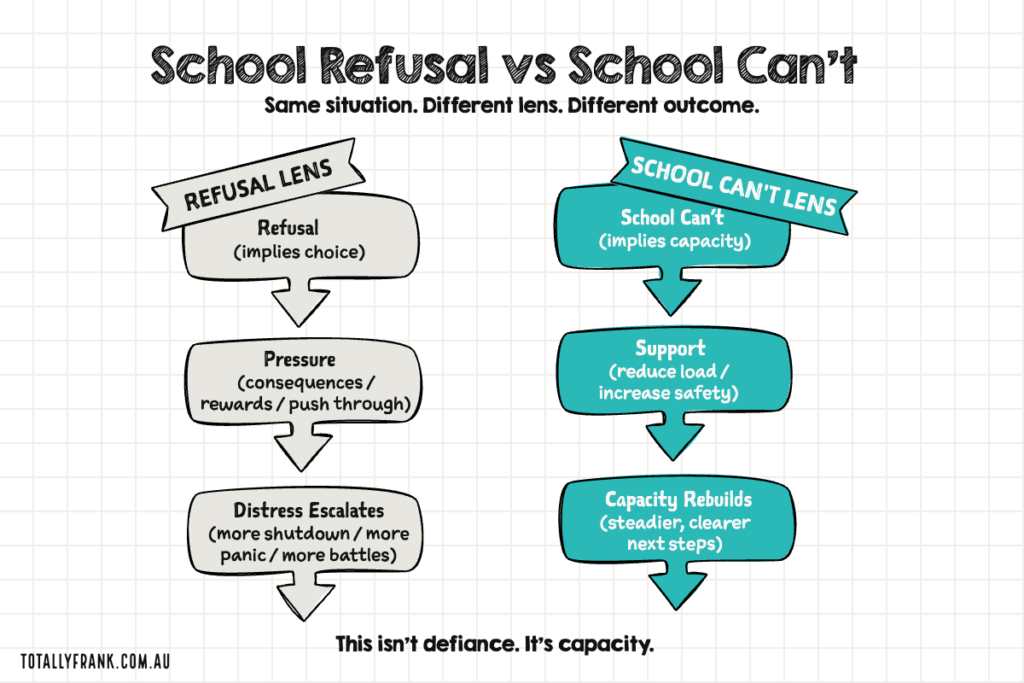
The difference matters, because it changes what helps:
This isn’t about semantics. It’s about responding to distress with the right kind of support.
If you’d like a steadier voice while school feels heavy
I send one email a week – calm reflections and practical support for neurodivergent families when school is getting hard.
No pressure. No perfection. Just steadiness in the middle of it.
Looking for other parents navigating this?
If school isn’t working for your child, you’re not alone.
I run a small Facebook group for neurodivergent homeschooling families where parents share experiences, ask questions, and support each other through the messy middle.
No judgement. No pressure. Just people who understand..
Why The Words Matter (because they change what adults do)
The word refusal can sound like choice. It can imply:
But can’t points to something else:
And that difference matters because it changes what happens next:
When adults hear “refusal”, they often reach for:
When adults hear “can’t”, they’re more likely to reach for:
This shift – from behaviour to capacity – is the heart of a school can’t framework.
What People Usually Mean By “School Refusal”
It’s a Broad Label, Not a Diagnosis
In everyday use, “school refusal” usually means:
a child is not attending school consistently, or is struggling to attend, because something about school has become difficult.
That “something” can include:
That’s why families often feel confused. The label describes the outcome (non-attendance), not the cause.
Why It Often Turns Into Conflict
The word refusal can accidentally flip the situation into a compliance problem.
Then the focus becomes:
Instead of:
And when the wrong problem gets solved, the distress usually grows.
What “School Can’t” Explains (the capacity frame)
“School can’t” is a way of describing school distress that centres capacity and nervous system overload, rather than choice or defiance.
“Can’t” Doesn’t Mean “Never”
It usually means:
This matters, because “never again” language can spike panic – in parents and schools.
Capacity Is Affected By Nervous System Load
Capacity isn’t fixed. It changes when your child is dealing with:
And when stress goes up, executive function often goes down – things like starting tasks, shifting gears, coping with frustration, and staying regulated.
What This Changes
If you’re using a school can’t lens, the goal shifts from:
to
Signs It’s Capacity, Not Defiance
You might notice:
Permission line: A child can look “fine” at school and still be paying for it later.
If you’re seeing a pattern of increasing exhaustion and reduced coping over time, that can also fit with autistic burnout risk – especially when demands keep exceeding resources.
Common Drivers of School Can’t (Without Turning This Into A Deep Dive)
School can’t is rarely about one single thing. It’s usually a build-up.
Common themes include:
What To Do With This Information (Gentle Next Steps)
You don’t have to solve everything today. Start with the smallest, least harmful shift.
Step 1 – Take The Pressure Off (Even Slightly)
Step 2 – Reduce Load And Protect Recovery
Step 3 – Communicate Capacity, Not Behaviour, To The School
Use words like:
This keeps the conversation out of blame and into support.
Step 4 – Choose Next Options Without Rushing
Options might include:
Frequently Asked Questions
Is school can’t a real term or just a parenting phrase?
It’s a capacity-based framework some clinicians and researchers use to reframe school distress away from blame and toward nervous
system load and support needs.
If I stop pushing, am I reinforcing avoidance?
Not necessarily. Reducing pressure is often about preventing distress from escalating and protecting recovery – not “giving in”. The goal is to respond to capacity, not fear.
What if the school says it’s behavioural?
You can calmly redirect the conversation to distress and capacity: what your child can and can’t tolerate right now, and what reduces load.
What if my child won’t tell me why?
That’s common. Some kids can’t explain it, or don’t have words for body-based overwhelm. Patterns (mornings, transitions, after-school collapse) often tell you more than a verbal explanation.
Can my child be “fine” at school and still be overwhelmed?
Yes. Masking and over-coping can look like “fine” – until the crash comes later.
What if it’s bullying, but they can’t say it?
Trust the distress and stay curious. Keep the door open and look for indirect signs. If you suspect bullying, treat it as a safety issue, not a motivation issue.
When should I seek professional support?
If distress is escalating, your child is shutting down, self-harm is present, panic is frequent, or the family is in crisis mode, it’s worth reaching out for support.