If you’re googling “what is school refusal”, chances are you’re living it. School refusal is when a child struggles to attend because their nervous system is overwhelmed – not because they’re lazy or “won’t”.
School Refusal Isn’t Bad Behaviour – It’s Distress
If you’re searching “what is school refusal”, chances are mornings have become a cycle of panic, shutdown, bargaining, or distress spiking – and you’re exhausted.
The hard part is that other people often see “won’t”, while you’re living “can’t”. That gap creates blame, pressure, and advice that makes things worse.
You’re not failing. This is frightening, isolating, and it can make you doubt your own judgement – especially when you’re being pushed to “get them there”.
School refusal is ongoing difficulty attending school because your child is in distress – not because they’re lazy, manipulative, or poorly parented.
In this article, I’ll explain what school refusal is, what it isn’t, how it can show up (including physical symptoms), and why the “won’t” lens so often misses what’s really happening.
A Quick Summary
School refusal isn’t usually a behaviour problem – it’s a nervous system problem.
For many neurodivergent kids, “refusing” is what it looks like when:
If you’re in this right now, you’re not failing. This isn’t about stricter parenting – it’s about safety, capacity, and reducing pressure so you can see what your child is actually telling you.
If you’d like a steadier voice while school feels heavy
I send one email a week – calm reflections and practical support for neurodivergent families when school is getting hard.
No pressure. No perfection. Just steadiness in the middle of it.
Looking for other parents navigating this?
If school isn’t working for your child, you’re not alone.
I run a small Facebook group for neurodivergent homeschooling families where parents share experiences, ask questions, and support each other through the messy middle.
No judgement. No pressure. Just people who understand..
What School Refusal Is
School refusal is a pattern where a child has ongoing difficulty attending school, usually because school has become linked with distress.
That distress can look like:
Sometimes it builds slowly. Sometimes it seems to arrive suddenly. Either way, it’s often a sign that your child’s capacity has dropped and their nervous system is trying to protect them.
And yes – avoidance can be part of it. But in school refusal, avoidance is usually a signal, not a strategy.
What School Refusal Isn’t (the myths that make it worse)
When people don’t understand what’s happening, they reach for the simplest story. Unfortunately, the simplest story is often the most harmful.
It isn’t laziness
Kids who are genuinely coping don’t usually need to be dragged, bribed, or forced.
Many children experiencing school refusal still want to go. They talk about friends. They talk about missing out. They promise they’ll try tomorrow.
But when morning comes, their body says no. That isn’t laziness. That’s distress.
It Isn’t Bad Parenting
School refusal can make parents feel judged from every angle – school, family, friends, even strangers.
You might hear:
But most parents in this situation have already tried everything they were told to try. They’ve stayed calm. They’ve held boundaries. They’ve used rewards. They’ve used consequences. They’ve explained, negotiated, soothed, and reset routines more times than they can count.
School refusal isn’t a sign you’re failing. It’s a sign your child is struggling.
It Isn’t “Just Anxiety” You Can Push Through
Anxiety can absolutely be part of school refusal – but the answer isn’t always more pushing, faster plans, or tougher expectations.
If a child is already overloaded, pressure can tip them further into panic, shutdown, or explosive distress. Sometimes the most helpful early step isn’t “get them back in at any cost”.
It Isn’t the Same as Truancy’
Sometimes it’s slowing down enough to understand what their nervous system is reacting to. This one matters, because the responses are completely different.
If distress is driving the behaviour, a punitive response usually adds more pressure to an already overwhelmed system.
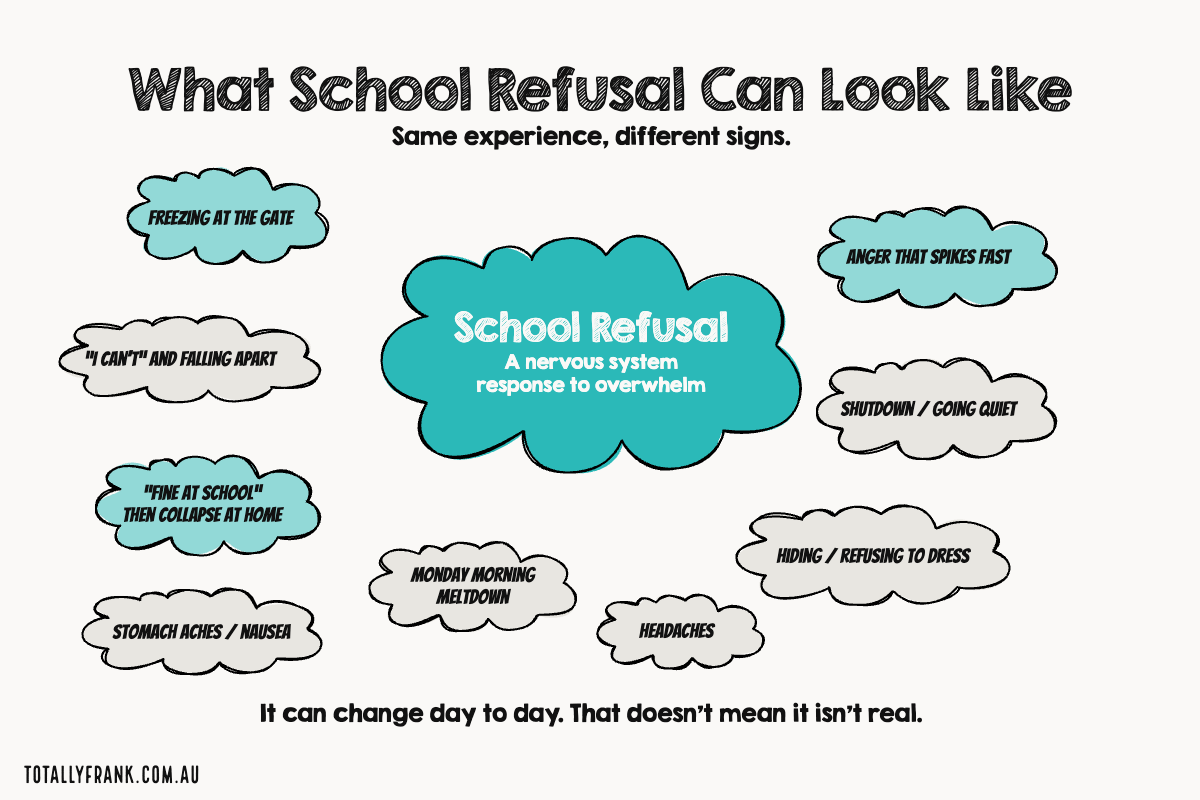
What School Refusal Can Look Like (real life, not textbook)
School refusal isn’t one neat presentation. It can be messy, confusing, and inconsistent.
It might look like:
And it can come in waves:
That inconsistency doesn’t automatically mean manipulation. It often means capacity is fluctuating – and school is pulling from a tank that’s already close to empty.
Why “Won’t” Is The Wrong Lens (and what to use instead)
When school refusal gets framed as “won’t”, the response tends to be:
But if school refusal is a nervous system response, those responses miss the point.
A capacity-based lens asks different questions, like:
School non-attendance is rarely one simple cause. It’s usually a build-up of pressures – and families often end up carrying the blame for something that’s bigger than them. When we understand this as a nervous system response, we can adjust our response too – with less pressure, less punishment, and more support.
School Refusal and Neurodivergence
In a large UK parent survey school refusal was dominated by neurodivergent students. It was particularly prevalent in autistic kids but was also common in ADHD and demand avoidant kids.
Not because neurodivergent kids are “less resilient”. But because school can be a high-load environment.
For autistic kids, school can involve:
For ADHD kids, it can involve:
And for demand-avoidant kids, the pressure of attendance itself can become the trigger.
When a child’s nervous system starts linking school with threat, the body responds accordingly – even if the child can’t fully explain why.
The Most Important Takeaway
School refusal is not a parenting verdict.
It’s information.
Understanding is a first step. It won’t remove the pressure, but it can help you move from panic to steadier footing. Once you can see the pattern, you can start shaping an environment that lowers pressure and supports your child’s nervous system.
You don’t need to solve everything today. You need a clearer lens – and a little less blame.
Frequently Asked Questions
What is school refusal?
School refusal is ongoing difficulty attending school linked with distress – emotional, physical, or both.
Is school refusal a choice?
Sometimes avoidance is a coping response, not a conscious choice. A capacity-based lens helps you look underneath the behaviour.
What’s the difference between school refusal and truancy?
Truancy usually involves skipping school without distress. School refusal is driven by distress and overwhelm.
Can autistic kids experience school refusal?
Yes. Sensory load, masking, social stress, and constant demand can make school unsustainable for some autistic kids.
Why is my child “fine” once they get there?
Some children push through or mask at school, then release the distress later when they feel safe.
Does school refusal mean we have to homeschool?
Not necessarily. This page is about understanding what’s happening first. Decisions can come later.
You’re welcome to join my Facebook group Neurodivergent Homeschooling, where parents share experiences and support each other when school stops working.