If mornings have turned into dread, shutdowns, or battles you never wanted – you’re not doing anything wrong. When school stops working for a neurodivergent child, it’s rarely about attitude. It’s usually about capacity running out.
When School Becomes Too Much For Your Child
If school used to be hard-but-doable, and now it feels physically or emotionally impossible, you’re not imagining it.
This is the part that can make you feel like you’re losing your footing – because everyone else is still talking about motivation, behaviour charts, “just keep going”, and attendance… while your child’s whole body is saying no.
And when you’re living inside that, it’s not just stressful. It’s heartbreaking.
I’ve been that parent – trying to hold it together on the outside while everything in our home quietly revolved around getting through the next school day.
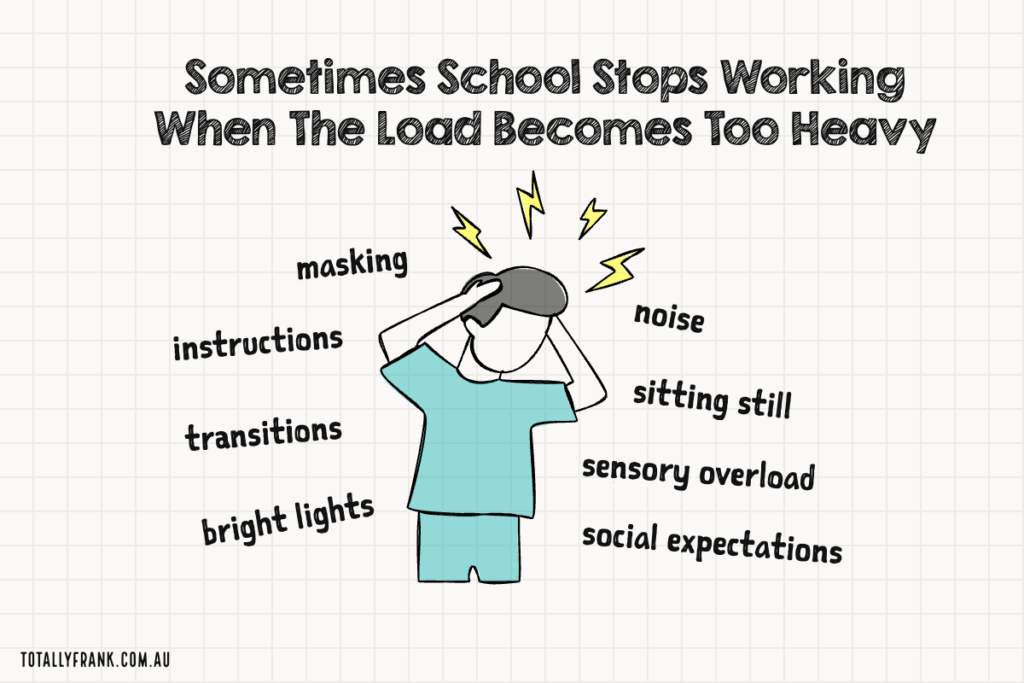
For many neurodivergent kids, school doesn’t “stop working” because they’ve become lazy, stubborn, or oppositional. It stops working because the load has finally outweighed their capacity.
This page is here to help you understand what’s happening – without pressure and without needing to make any big decisions today.
Because you don’t need a perfect plan right now. You need a clearer lens.
A Quick Summary
When school stops working for neurodivergent kids, it’s usually not a motivation problem – it’s a capacity problem.
Often, it’s because:
You don’t need a perfect plan today. You just need a clearer lens – so you can reduce pressure and support safety first.
If you’d like a steadier voice while school feels heavy
I send one email a week – calm reflections and practical support for neurodivergent families when school is getting hard.
No pressure. No perfection. Just steadiness in the middle of it.
Looking for other parents navigating this?
If school isn’t working for your child, you’re not alone.
I run a small Facebook group for neurodivergent homeschooling families where parents share experiences, ask questions, and support each other through the messy middle.
No judgement. No pressure. Just people who understand..
When School Stops Working, it’s Usually Capacity – Not Character
A lot of parents get told (directly or indirectly) that their child is:
But distress doesn’t always look the way adults expect.
Sometimes it looks like:
When school becomes unsafe or overwhelming for a child’s nervous system, the response isn’t a thoughtful decision. It’s protection.
That’s why “more consequences” or “just push through” often makes things worse.
The Hidden Workload of School (the stuff you can’t see)
When people say, “But school is the same for everyone,” they’re missing something important.
School might be one environment – but it can be a completely different experience depending on how your child’s brain and body process the world.
Sensory Load
School can mean hours of:
For some kids, this is like running a phone on full brightness, all apps open, all day. They might cope for a while. Then the battery drops.
Demand Load
Even in the best schools, the demand is constant:
For kids with executive function challenges, stress can make planning, shifting, and starting tasks much harder. The timetable can become the problem – not the child.
Social and Performance Load
School requires:
Even if your child likes their teacher. Even if they have friends. Even if they’re bright.
It’s still a lot.
Masking, Over-Coping, and the Crash That Comes Later
One reason school distress gets misunderstood is because some kids hold it together until they can’t.
They might:
Then you see:
That doesn’t mean home is the problem. It often means home is the only place their nervous system feels safe enough to fall apart.
And if this has been building for months (or years), a weekend doesn’t refill the tank. Rest helps – but chronic overload usually needs load reduced, not more pushing.
Why “More Support at School” Sometimes Still Doesn’t Help
This is the part that can feel confusing and heartbreaking.
Because many families do try:
And still, things keep unravelling. That doesn’t mean you didn’t try hard enough.
Sometimes “support” accidentally adds more pressure, like:
And sometimes accommodations can’t touch the core issue: the environment still doesn’t fit.
School non-attendance is rarely one simple cause. It’s usually a build-up of pressures – and families often end up carrying the blame for something that’s bigger than them. When we understand this as a nervous system response, we can adjust our response too – with less pressure, less punishment, and more support.
So if you’ve been living in a cycle of “try another thing, fail again,” you’re not alone. And you’re not doing it wrong.
A Steadier Reframe to Hold Onto
If school has stopped working, your child is not broken. They’re overloaded. And you don’t need to solve the entire future today.
For now, it can be enough to say:
Understanding is a first step. It won’t remove the pressure, but it can help you move from panic to steadier footing. Once you can see the pattern, you can start shaping an environment that lowers pressure and supports your child’s nervous system.
Frequently Asked Questions
Why does school stop working for neurodivergent kids?
Because the overall load (sensory, demand, social, performance) can exceed capacity – especially when stress accumulates over time.
Why does it look like it happened “all of a sudden”?
Sometimes the coping has been happening quietly for a long time. When capacity finally drops, the change looks sudden from the outside.
Why is my child worse after school than at school?
Many kids hold it together at school and release the distress at home, where they feel safer.
Why don’t rewards or consequences fix it?
Because distress isn’t a choice. When the nervous system is in protection mode, logic and motivation don’t work the way adults expect.
Does this mean we have to homeschool?
Not necessarily. Some families do, some don’t, and many move through stages. You can learn what’s happening first, and decide later.
Why doesn’t extra support at school always help?
Support can help – but if it increases pressure or the environment still doesn’t fit, capacity can keep dropping anyway.
You’re welcome to join my Facebook group Neurodivergent Homeschooling, where parents share experiences and support each other when school stops working.