Sometimes schools add more support, yet a child continues to struggle. Even when everyone involved is trying to help. If you’re wondering why accommodations haven’t solved the problem, this guide explains what might really be happening inside your child’s nervous system.
When school adds support but your child still gets worse
If your child is neurodivergent and school is getting harder, you’ve probably reached the “support” stage.
Meetings. Plans. Adjustments. Extra help.
And for some kids, those changes genuinely help.
But for other kids, something confusing happens:
Even with more support, school still isn’t workable.
The distress continues. The mornings get heavier. The shutdowns or meltdowns intensify. The “we’re doing everything” feeling grows.
This is often the point where parents start turning the blame inward.
Maybe we didn’t advocate well enough.
Maybe we’re reinforcing it.
Maybe there’s something wrong at home.
If you’re here, I want you to hear this clearly:
Sometimes the issue isn’t that your child needs more support.
Sometimes parents reach a point where school accommodations simply aren’t working, even though everyone involved is trying to help.
Sometimes the issue is that the overall load of school is still too heavy for their nervous system – even with accommodations.
This page will help you understand why that happens (without blaming you, your child, or the school), so you can make steadier choices from here.
A Quick Summary
School accommodations can be genuinely helpful.
But sometimes they don’t solve the real problem – because they’re trying to support a child inside an environment that is still overloading them.
This can happen when:
If accommodations aren’t helping, it doesn’t automatically mean you’ve failed.
It may simply mean the current environment can’t be made workable enough – and that’s important information.
If you’d like a steadier voice while school feels heavy
I send one email a week – calm reflections and practical support for neurodivergent families when school is getting hard.
No pressure. No perfection. Just steadiness in the middle of it.
Looking for other parents navigating this?
If school isn’t working for your child, you’re not alone.
I run a small Facebook group for neurodivergent homeschooling families where parents share experiences, ask questions, and support each other through the messy middle.
No judgement. No pressure. Just people who understand..
What school accommodations are meant to do
School accommodations (sometimes called adjustments) are meant to do one main thing:
Remove barriers so a child can access learning with less stress.
They’re not supposed to “fix” a child.
They’re supposed to change the conditions around the child so school is more doable.
For many neurodivergent kids, that can genuinely help.
What accommodations can look like
Accommodations are usually practical changes to the how of school, like:
Sometimes they’re formal (ILP/IEP/PLP – depends on your state and school).
Sometimes they’re informal classroom agreements.
What accommodations are designed to help with
When accommodations are well-matched, they can reduce:
And for some kids, that reduction is enough to make school workable again.
The important nuance
Accommodations work best when the barrier is specific and solvable.
For example:
In other words: the adjustment targets the main stress point, and the nervous system gets some breathing space.
And that’s where things can start to improve.
Why “trying harder” hasn’t fixed it
If you’re reading this, there’s a good chance you’ve already tried a lot.
More meetings.
More support plans.
More strategies.
More encouragement.
You may have been told your child just needs the right support.
But many parents discover something confusing:
Even when more support is added, things don’t necessarily get better.
Sometimes they get worse.
Mornings become harder.
School avoidance increases.
Anxiety grows.
Your child starts saying they’re sick, or tired, or just can’t go.
And quietly, another message often begins to appear between the lines:
Maybe your child isn’t trying hard enough. Maybe you need stronger boundaries. Maybe something in the family environment is contributing.
For many parents, this is the moment self-doubt starts to creep in.
But there is something important to understand.
When a neurodivergent child is struggling in the school system, it usually isn’t because nobody tried hard enough.
Most of the time, the adults involved are trying incredibly hard.
Teachers are adjusting.
Parents are supporting.
Schools are adding accommodations.
Yet the child is still overwhelmed.
That’s the part that feels impossible to explain.
Because from the outside, it looks like support has been added.
But from the child’s nervous system, the overall load may still be too high.
And when that happens, adding more support inside the same system doesn’t always solve the problem.
Sometimes the system itself is the pressure point.
This isn’t usually a failure of effort.
The Hidden Load Many Neurodivergent Kids Carry
When a neurodivergent child struggles at school, it’s rarely just about the learning itself.
Often, it’s about the total load their nervous system is carrying throughout the day.
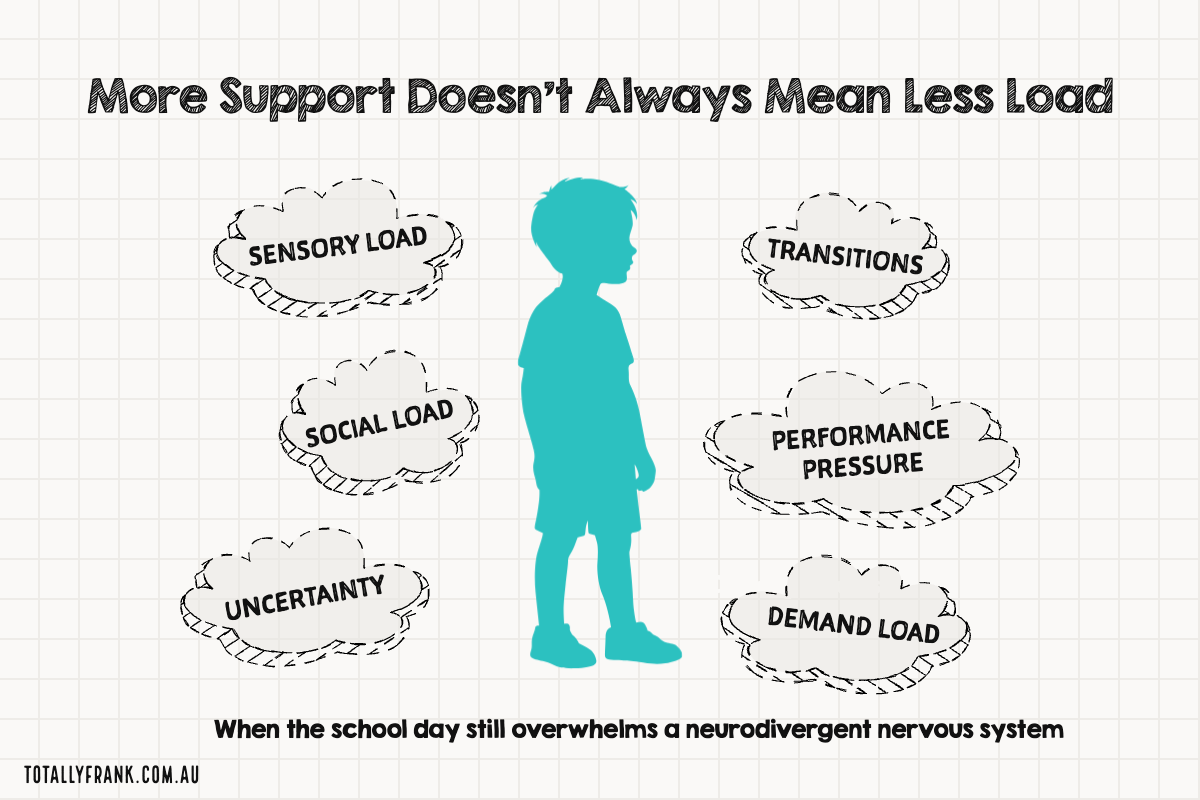
School environments place many simultaneous demands on children:
For many neurotypical children, these demands are manageable.
For many neurodivergent children, they can stack up quickly.
A child might be trying to:
All while being expected to stay calm, focused, and cooperative.
That’s a lot for any nervous system to hold.
And when that load becomes too high, something important happens:
The brain shifts from learning mode into survival mode.
When the nervous system detects threat or overwhelm, the brain prioritises safety and regulation over higher-level thinking.
Neuroscience and education research consistently shows that elevated stress can affect working memory, attention, and learning processes in the brain.
In other words:
When a child feels overwhelmed, their brain is not refusing to learn.
It is protecting itself.
This is why a child might seem capable at home, but completely shut down at school.
Or why a child who loves learning can suddenly refuse worksheets, writing tasks, or structured lessons.
From the outside, it can look like behaviour.
But underneath, it’s often a nervous system that has reached its limit.
And when that limit is reached day after day, school can start to feel unsafe.
Many neurodivergent kids aren’t refusing to learn.
They’re refusing the level of pressure their nervous system can’t sustain.
If the overall load of the environment hasn’t changed, your child’s nervous system may still be carrying more than it can safely hold.
And when the nervous system is overloaded, more support inside the same system doesn’t always reduce the pressure.
Why school accommodations sometimes don’t solve the problem
Once a school recognises your child needs support, it can feel like a turning point.
Plans are written. Adjustments are made. Extra people get involved.
And sometimes, that does help.
But in other cases, families find themselves in a painful loop:
Support is added… and the distress continues.
This is usually because accommodations tend to do one of two things:
They lower one barrier – but the total load stays the same
A quieter space might help with noise.
Extra time might help with time pressure.
Typing might help with writing.
But if your child is also carrying:
…then removing one barrier doesn’t necessarily make the day feel safe.
It can still be too much.
Sometimes “support” accidentally adds pressure
This is the part nobody means to do – but it happens.
More support can come with:
For some neurodivergent kids, especially those with high anxiety or a demand-avoidant profile, that can feel less like help and more like:
“I’m being managed.”
And when a child already feels overwhelmed, that feeling can increase distress – even if everyone’s intentions are kind.
Support can’t always change the parts of school that are inherently hard
Some of the hardest parts of school aren’t academic.
They’re structural:
So the school can add accommodations – and still be unable to reduce the overall load enough for your child’s nervous system.
That’s not a failure of effort.
It’s a mismatch between what your child needs and what the environment can realistically offer.
Accommodations can remove barriers.
They don’t always reduce the total load of school.
When support becomes “proof” – and families start carrying the blame
After accommodations are added, there’s often an unspoken expectation. If the right supports are now in place, things should start improving.
So when the distress continues, everyone involved starts trying to explain why.
Teachers may feel confused.
Parents feel increasingly worried.
The child is still overwhelmed.
And slowly, the focus can begin to shift.
Instead of asking whether the environment is still too demanding, the conversation can start circling around questions like:
These questions usually aren’t asked with blame in mind. Most teachers genuinely want to help.
But when a system is under pressure to make school work, the explanations available inside that system tend to focus on:
For families, this can be one of the hardest stages.
Because it can start to feel like the message is:
If the supports are there and it still isn’t working… the problem must be somewhere else.
Often, that “somewhere else” becomes the family.
I remember sitting in a meeting where the conversation quietly turned toward whether something in our family might be contributing.
Parents begin questioning themselves:
When nothing seems to work, families often end up carrying the weight of explaining why.
But when a child’s nervous system is already overloaded, more pressure rarely solves the problem.
In fact, it often makes the situation more fragile.
Research into school attendance difficulties increasingly highlights that many children who struggle to attend school are experiencing significant emotional distress, particularly neurodivergent children whose needs are not fully met within the school environment.
This doesn’t mean schools are failing.
And it doesn’t mean families are failing.
Sometimes it simply means that the system cannot reduce the overall load enough for a particular child to feel safe and able to learn.
And recognising that reality can be the moment things start to make more sense.
When a child is overwhelmed, asking them to cope harder doesn’t reduce the load – it increases it.
What can help when school support isn’t enough
When families reach this point, it can feel like there are only two options:
Push harder… or give up.
But those usually aren’t the only choices.
Often the most helpful step is to pause and look at the situation through a different lens.
Instead of asking:
How do we make our child cope with this environment?
The more useful question can become:
What kind of environment helps our child feel safe enough to learn?
Because learning doesn’t just depend on intelligence or effort.
It depends heavily on whether a child’s basic psychological needs are being supported.
Research into motivation and learning consistently shows that children engage and learn best when they experience three core conditions:
When these needs are supported, motivation and engagement tend to increase.
When they’re consistently frustrated, distress and disengagement often grow instead.
For some children, school environments are able to meet those needs. For others, the structure and demands of school make it much harder.
That doesn’t mean learning can’t happen.
It may simply mean learning needs to happen in a different way, at a different pace, or in a different environment.
Sometimes those changes happen within school.
Sometimes they happen outside of it.
But the goal is always the same:
to create conditions where your child’s nervous system can settle enough for learning to become possible again.
And when that happens, many children begin to show their curiosity, creativity and capability much more clearly.
Gentle Next Step
If you’re starting to wonder whether homeschooling might be part of your path, you’re not alone.
Many families reach that question gradually, after trying many ways to make school work.
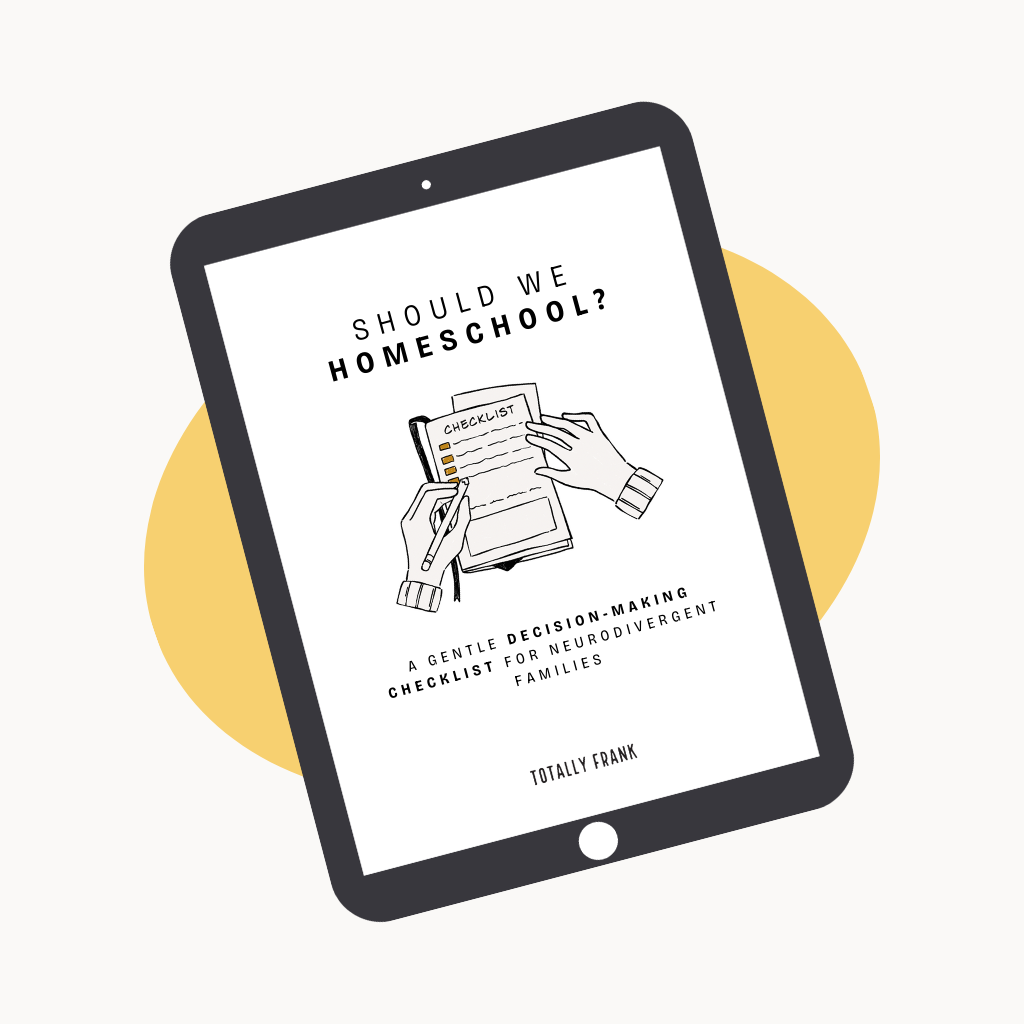
If it would help to think it through calmly, I’ve created a free guide:
Should We Homeschool?
It walks through the questions many neurodivergent families face when school stops working, and helps you sort through the decision without pressure.
Frequently Asked Questions
1) Why aren’t school accommodations working for my autistic child?
Accommodations can remove specific barriers (like writing load, noise, or time pressure), but they don’t always reduce the overall load of school. If your child is carrying high sensory, social, demand, and performance pressure all day, one or two adjustments may not be enough to make the environment feel safe or doable. That doesn’t mean you asked for the wrong thing – it may mean the mismatch is bigger than a single change.
2) Can more support at school make things worse?
Sometimes, yes – even with good intentions. Extra support can unintentionally add pressure through increased monitoring, prompting, attention, or expectations to “show progress.” For some neurodivergent kids (especially those with high anxiety or demand avoidance), that can feel like more demand rather than less, and distress can increase.
3) Is school refusal the same as “school distress”?
Many families find “school distress” fits better than “school refusal,” because it centres what the child is experiencing – not what they’re failing to do. Some research and parent-report studies highlight that school attendance difficulties are often underpinned by significant emotional distress, particularly for neurodivergent children whose needs aren’t fully met in the school environment.
4) How do I know if my child is overwhelmed, not “being defiant”?
Look for signs of nervous system overload, such as:
These signs often point to overwhelm rather than motivation problems.
5) What should we do if school support still isn’t enough?
Start by lowering overall load where you can and prioritising safety and recovery. Helpful steps often include:
You don’t need to decide everything at once. You just need a steadier lens and one next step.
6) Why can school be especially hard for children with ADHD?
School environments place constant demands on attention, organisation, and task switching. For children with ADHD, these demands can quickly create cognitive overload. Even when a child is intelligent and curious, the effort required to sustain attention, follow multi-step instructions, and manage transitions can be exhausting. Over time, that fatigue can lead to frustration, avoidance, or distress.
7) Why do ADHD accommodations sometimes still fail?
Many ADHD accommodations focus on helping a child stay on task (for example, reminders, prompts, behaviour charts, or extra supervision). While these can help some children, they can also increase the sense of being watched or corrected. If a child is already feeling overwhelmed or discouraged, more monitoring can unintentionally increase stress rather than reduce it.
8) Can ADHD children experience school distress or school refusal?
Yes. While school distress is often discussed in relation to autism, many ADHD children also experience it. Difficulties with attention, emotional regulation, and executive functioning can make the school day feel constantly demanding. When a child repeatedly feels behind, criticised, or exhausted, avoiding school can become a way for their nervous system to escape the pressure.’
You’re welcome to join my Facebook group Neurodivergent Homeschooling, where parents share experiences and support each other when school stops working.